PDF Download the Ink & Mayhem Universe Guide 24.0 MB
This is the chapter where the Exodus NDS core bends to fit a cartoon universe. Damage becomes Elasticity. Death becomes a momentary absence. Story Points become Gag Tokens and Chaos. Characters lock their identities so the world can safely revolve around them. The rule of funny receives official standing. Read this chapter carefully; everything downstream assumes you have.
Overview
This chapter lists every rule in this book that modifies, replaces, or adds to the Exodus NDS Core Rules. If a rule here conflicts with the core rules, this chapter takes precedence for games set in Ink & Mayhem.
The chapter is divided into two sections. Modifications to Core Mechanics covers renames, replacements, and small changes to existing Core systems, Wounds become Elasticity, Fortune and Peril become Gag Tokens and Chaos, and so on. Setting-Specific Subsystems introduces wholly new mechanics that exist only in Ink & Mayhem, the Shtick System, Cartoon Physics, the Fourth Wall, Relationships, and the Session / Season / Studio Loop.
Modifications to Core Mechanics
Character Creation
Replaces: Core Background-style characteristic setup during character creation.
Ink & Mayhem characters choose a Type in Chapter Three instead of beginning with all six characteristics at 2. Each Type provides a fixed cartoon-archetype array, and the player may reassign one point within the limits listed in Chapter Three. Type does the job a Background-style starting package does in other Exodus NDS settings: it sets the mechanical silhouette before XP spending.
Because Type arrays start slightly stronger than the Core baseline, Ink & Mayhem characters begin with 80 starting XP instead of the Core default. This XP is spent after choosing Type and may be used for characteristic increases, skills, and talents per the Core Rules. During character creation, a toon may begin with one profession skill at rank 3; all other starting skill caps follow the Core Rules. Type reassignment and the Wildcard’s bonus cannot raise any characteristic above 3 before XP spending, but XP can still raise characteristics to the normal Core character-creation maximum. Shtick replaces the Career-style identity layer: it tells the table what your toon does on screen, and it governs In-Shtick and Against-Shtick play below.
Talent Compatibility
Ink & Mayhem uses the Core universal talent cost model unless a talent says otherwise. Core talents remain available; read them with the setting’s renames applied (see Elasticity, Gag Tokens & Chaos, and the skill rename table under Skills, all in this chapter). Hardy increases maximum Elasticity instead of Wound Points. Steadfast and Twist of Fate are unchanged. Growth and Greater Growth are available only with GM permission at the Core recommended costs and should usually be tied to a Season or Studio-scale development rather than routine advancement.
Derived Attributes
Defines: Ink & Mayhem character-derived values.
After Type selection and XP spending, calculate derived attributes as follows:
- Elasticity Points: 10 + Might, modified by talents, Type abilities, and other explicit rules.
- Strain Points: 10 + Willpower, modified by talents and other explicit rules.
- Resistance: half Might, rounded up, + armor Resistance Bonus + other explicit bonuses.
- Melee Defense and Ranged Defense: both start at 0, then add equipment, talents, cover, and other explicit bonuses.
Unless a rule says otherwise, all player toons are Scale 1 regardless of cosmetic Look.
Skills
Modifies: Core Skill List.
Ink & Mayhem keeps the Core skill framework but changes the list for the setting. The following Core skill names are renamed for toon play:
| Core Skill | Ink & Mayhem Skill |
|---|---|
| Unarmed | Brawl |
| Reflexes | Coordination |
| Fortitude | Resilience |
| Operate | Drive |
The remaining Core skills stay available unless Chapter Four says otherwise, including Readiness, Survival, Subterfuge, Medicine, Science, and Intimidation. Ink & Mayhem also adds Gag-Craft, Pratfall, Fourth-Wall, and Performance. These four Cartoon Skills count as profession skills for every Ink & Mayhem toon.
Type and Shtick replace the Core Background / Career method for determining other profession skills. Use the Type and Shtick profession skill tables in Chapter Three, Step 7. If a skill appears more than once, it is still simply a profession skill; duplicate listings do not reduce its cost further or grant free ranks. Leadership and Resilience use Willpower as their default characteristic in this setting, as described in Chapter Four.
Automatic Successes
Some Ink & Mayhem abilities grant automatic Successes. Add these after rolling and after symbol cancellation. Automatic Successes can turn a failed check into a successful one. Because they are added after the roll rather than as dice results, they create no Breakthroughs, cancel no Calamities, and count as zero Boons for any spend.
Elasticity
Replaces: Wound Points and Wounds.
A toon’s physical body is rubbery, ink-drawn, and resistant to permanent harm. Where a character in another Exodus NDS setting would track Wounds, a toon tracks Elasticity, the capacity of their cartoon body to absorb abuse before popping like a stretched balloon.
Elasticity Points are a current / maximum track; calculate the maximum under Derived Attributes, above. When a toon would take Wounds from any source, damage, environmental hazard, failed check with narrative consequence, reduce their current Elasticity by that amount after applying Resistance or other reductions.
When a toon’s current Elasticity drops to 0, the toon is Wiped Out (see below). For healing, see Recovery, below.
Strain
Modifies: Strain-based incapacitation.
Strain represents mental exhaustion, loss of composure, cracks in a toon’s professional facade. It still accrues and is still tracked per the Core Rules. A toon whose Strain meets their Strain Points is Rattled, functionally incapacitated until a scene change or appropriate intervention restores their composure.
A Rattled toon can still speak, usually in scrambled fragments, dazed muttering, or one perfect accidental line, but cannot take Actions, Maneuvers, or activate Bits until the Rattled state ends.
Because Wiped Out is always temporary (see below), Strain incapacitation is the real threat in Ink & Mayhem.
Wiped Out
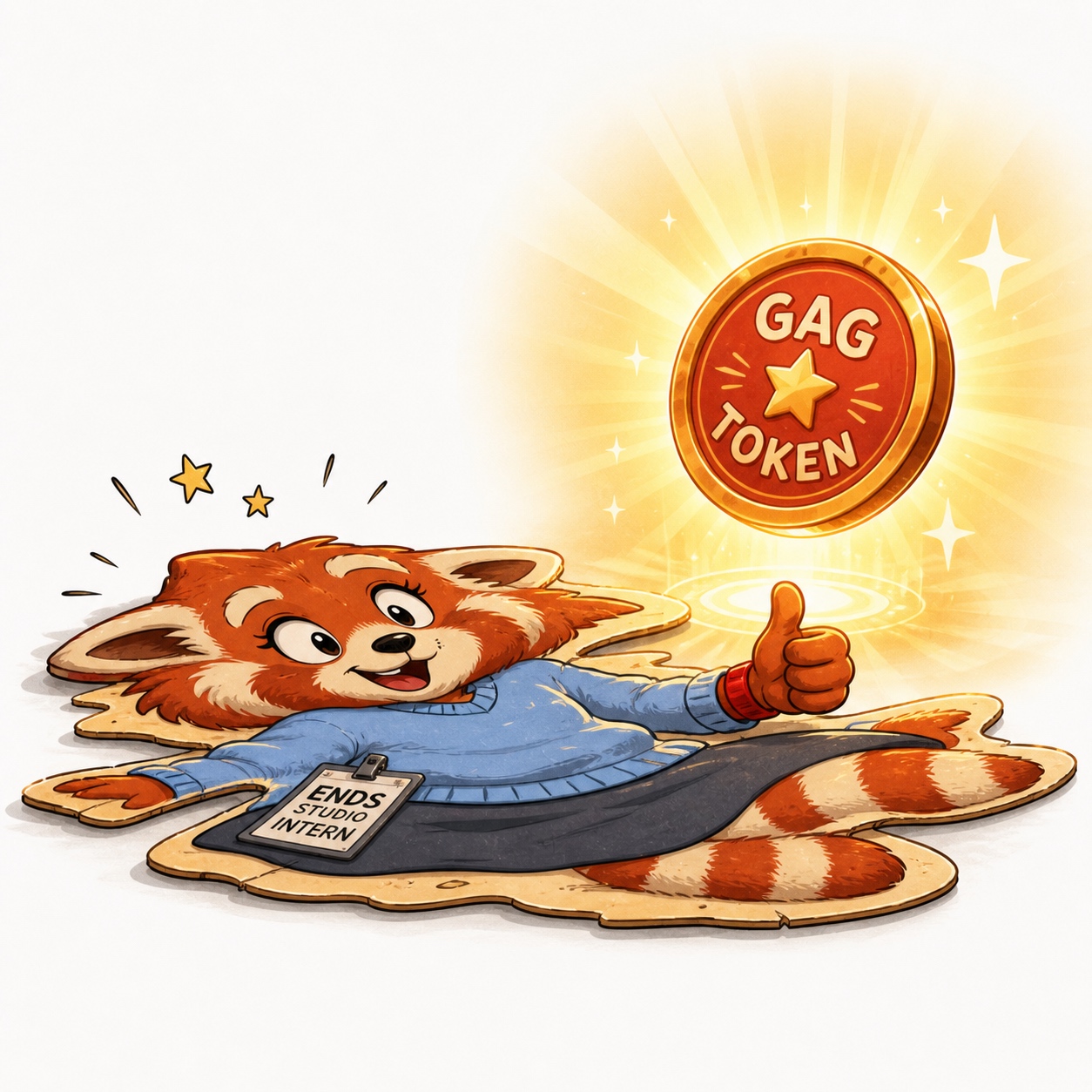
Replaces: Incapacitation from Wounds. Does not replace Strain-based incapacitation (see Strain above).
A toon with zero remaining Elasticity is Wiped Out. They are flattened, exploded, compressed into a cube, folded into origami, compressed through a keyhole, or otherwise spectacularly removed from the scene. A Wiped Out toon:
- Cannot take Actions, Maneuvers, or Quick Actions.
- Cannot be further damaged.
- May remain narratively present in the scene for comedic effect: speaking, observing, gesturing weakly, or occasionally complaining.
Returning. A Wiped Out toon returns at the start of the next scene at full Elasticity. In structured play, the toon may instead return at the top of the next round at 1 Elasticity by spending a Gag Token. Either way, the return is dramatic: the toon reassembles, unfolds, re-inflates, or walks back on-set patting themselves down.
Toons cannot truly die. The Wiped Out condition is always temporary; this is a Core Conceit and a mechanical guarantee.
Cartoon Conditions
Adds: setting-specific conditions.
| Condition | Effect |
|---|---|
| Blinded | The character cannot rely on sight. Add 2 Bane dice to sight-dependent checks, and the character cannot target anything beyond Engaged range unless another sense or ally clearly guides them. |
| Drenched | The character is soaked. Remove smoke, dust, and similar obscuring effects from them; add 1 Bane die to Coordination checks for the remainder of the scene. Dynamite and similar fuses they carry become inert until dried. |
| Rattled | The character is Strain-incapacitated; see Strain, above, for the full state. |
Gag Tokens & Chaos
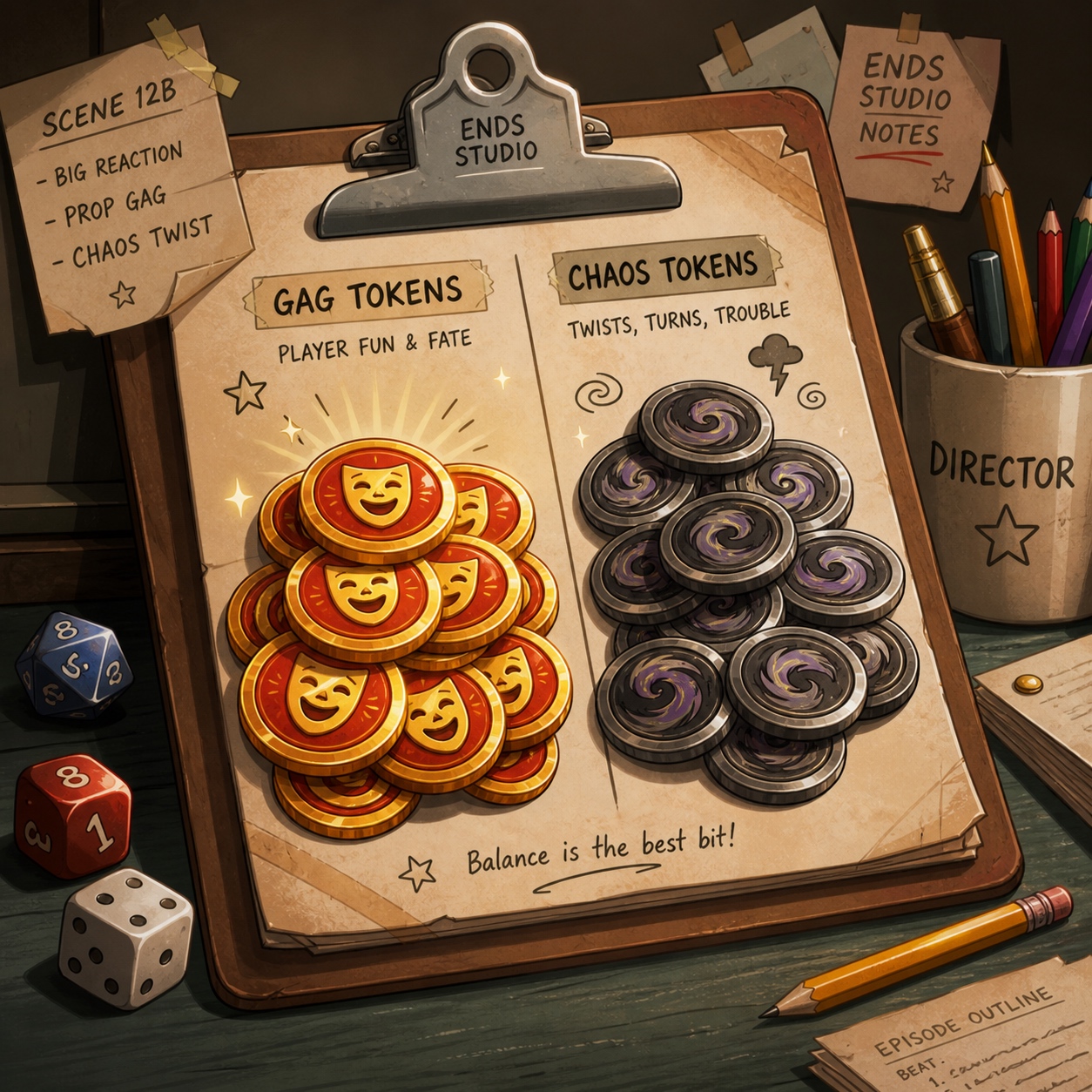
Renames and modifies: Fortune Points → Gag Tokens. Peril Points → Chaos Points.
The Story Points economy from the Core Rules is retained, with new names and one setting-specific pressure valve.
| Core | Ink & Mayhem | Held By |
|---|---|---|
| Fortune Point | Gag Token | Players |
| Peril Point | Chaos Point | Game Master |
The usual mechanics are identical. When a Gag Token is spent, it becomes a Chaos Point in the GM’s pool. When a Chaos Point is spent, it becomes a Gag Token in the player pool.
At the start of each session, reset the pool to one Gag Token per player and one Chaos Point for the GM. Unspent Gag Tokens and Chaos Points from the previous session do not carry forward. Abilities that increase a toon’s starting Gag Tokens are added after this reset, and generated Chaos Points can increase the GM’s pool above its starting value during the session.
Ink & Mayhem also allows some Bits, Type abilities, and signature-character abilities to generate Chaos Points as a listed cost or side effect. Generated Chaos Points are added directly to the GM’s pool and do not require a player to spend a Gag Token first; this is a setting-specific escalation channel.
Some abilities grant or recover Gag Tokens directly. These are added directly to the player pool and do not require a Chaos Point to flip first. They can raise the player pool above its starting value during the session, but they still reset normally at the start of the next session.
All Core uses of Fortune and Peril apply to Gag Tokens and Chaos unmodified, upgrading a die, activating a Breakthrough or Calamity, introducing a narrative detail, and so on. Ink & Mayhem adds two setting-specific uses:
- Pop Back Early (Gag Token): A Wiped Out toon spends a Gag Token to return early; see Wiped Out, above, for the full rule.
- Invoke Cartoon Logic (Chaos Point): The GM spends a Chaos Point to declare that an improbable cartoon outcome simply happens: an anvil appears, a background character trips, a prop malfunctions. The Rule of Funny (see below) usually covers this for free; a Chaos Point is for significant cartoon interventions.
Symbol Interpretation in Ink & Mayhem
The six Exodus NDS symbols are unchanged in function, but their flavor in an Ink & Mayhem context shifts toward slapstick, gag, and spotlight. Use these readings as a starting point when narrating results.
| Symbol | Core Reading | Ink & Mayhem Flavor |
|---|---|---|
| The action succeeds. | The bit lands. | |
| The action fails. | The bit bombs, but the scene keeps moving. | |
| A small benefit. | A gag setup, a well-timed prop, a useful bystander. | |
| A small complication. | A prop malfunctions, a rival notices, a sign falls. | |
| A significant positive. | The Perfect Cartoon Moment: scene steal, reversal, spotlight. | |
| A significant negative. | Catastrophic Comedy: the whole building comes down, but everyone survives. |
Failure Does Not Stop the Action
Treat a failed check as escalation: the action goes wrong rather than stopping. The toon swings the mallet and misses; the trap triggers on the wrong target; the rocket fires in an unplanned direction, and the scene keeps moving. This is a core tonal ruling for the GM.
Recovery
Replaces: Recovery from Wounds (Core Rules, Chapter Twelve). Strain recovery is unchanged.
Elasticity recovers quickly and completely between scenes. There are no long-term injuries and no Critical Injuries in Ink & Mayhem.
Scene End. At the end of any scene, all toons recover to full Elasticity. No roll is required and no time passes; the cartoon cuts to the next setup.
Mid-Scene. During a scene, a toon may spend a Gag Token to recover 3 Elasticity. This may be done once per scene.
Wiped Out Return. See Wiped Out, above.
No Critical Injuries. The Critical Injury table from the Core Rules is not used in Ink & Mayhem. Instead, weapons use their Crit value as the base threshold for a Perfect Cartoon Moment. Because the result is stronger than a Core Critical Injury, the actual cost is Crit + 2 Boons on a successful attack. A Breakthrough on a successful attack counts as 3 Boons toward this threshold, and the attacker may spend additional Boons from the same roll to reach the total. If a weapon has no Crit value, use a default threshold of 5 Boons. A Perfect Cartoon Moment narrates a spectacular, scene-defining result (target launched into the stratosphere, folded into an accordion, stuck in a tree). The result is mechanically equivalent to Wiped Out.
Vehicles and Chases
Modifies and adds: Core vehicle terminology and chase handling.
Ink & Mayhem vehicle stat blocks use the Core vehicle fields Scale, Speed, Handling, Hull Points, and System Points, with cartoon interpretation. A vehicle reduced to 0 Hull Points is wrecked for comedy effect rather than destroyed permanently. Occupants are usually thrown clear with Strain and slapstick consequences rather than realistic injury.
For chase scenes, Ink & Mayhem uses the Cartoon Chase subsystem in Chapter Seven. This is a standalone structured-play mechanism built around the Lead Track, traps, tricks, gags, and dramatic chase endings.
Setting-Specific Subsystems
The Shtick System
The Shtick System answers the Ink & Mayhem paradox of how characters develop across sessions when cartoons are defined by their resistance to change: shtick is locked, but everything around the shtick grows.
Shtick Lock
Every toon chooses a Shtick at character creation (see Chapter Three: Character Creation). A Shtick is a single-sentence statement of the character’s cartoon identity, “The self-sabotaging genius,” “The unflappable straight man,” “The chaos magnet with a heart.” Once chosen, the Shtick is locked and cannot be changed during a Season. A rare Shtick change may happen only at Hiatus, after a Want has resolved and the table agrees the toon has reached a Season-scale turning point.
A Shtick is the character’s defining cartoon truth, deeper than a personality quirk or a background detail: the self-sabotaging genius will always, under pressure, sabotage themselves, and the unflappable straight man will always, even in catastrophe, remain unflapped.
Mechanical Effects of Shtick
Acting In Shtick. When a toon takes an Action that clearly expresses their Shtick, the trickster tricks, the striver strives, the spotlight thief steals a scene, the toon adds one Boon Die to the check. This bonus is granted by the GM’s ruling, not by the player’s claim.
Acting Against Shtick. When a toon takes an Action that contradicts their Shtick, the self-sabotaging genius actually pulls off a perfect plan, the unflappable straight man loses their cool, the check upgrades one Trial Die to a Crisis Die . The universe resists the change.
End of Session. If a toon played their Shtick meaningfully during a session, at least one Shtick-expressing moment, as judged by the table, they earn +2 XP. A toon who merely achieved their goals without expressing their Shtick earns only +1 XP: shtick is rewarded more than success.
Designer Note
The Shtick is a creative constraint, and creative constraints produce creative play. A player who embraces the lock and leans in will find more roleplay depth from a locked character than from a “free” character sheet.
Bit Repertoire
While the Shtick is locked, a toon’s Bit Repertoire, their signature moves, catchphrases, props, and tricks, grows over time.
Every toon begins with three filled Bit slots. Two of those slots are populated from the toon’s Shtick starter Bits (see Chapter Five: Talents & Bits), and the third may be any Bit from the Chapter Five catalog that fits the concept. Additional Bit slots cost 10 XP each, to a maximum of six slots. Learning a Bit for an empty slot costs 5 XP. A toon may replace one known Bit with another between sessions for 5 XP, with GM approval.
Bits are a setting-specific progression path, separate from talents. Unlocking a new Bit slot is the standard way to add a new cartoon move to a character’s Repertoire.
Bits come in two types:
- Passive Bits — always-on effects, usually defensive or reactive. Do not require activation.
- Active Bits — activated as an Action, Maneuver, Quick Action, or Triggered effect depending on the specific Bit.
Each Bit refreshes according to its listed Limit. A once-per-scene Bit refreshes at the start of each new scene. A once-per-session Bit refreshes at the start of each new session. Passive Bits are always on unless their entry says otherwise.
Shtick Refresh
Award Shtick XP at the end of each session, as described under Mechanical Effects of Shtick, above. Playing against Shtick, playing neutrally, and attempting to “grow beyond” the Shtick all earn only the baseline award. Shtick Refresh affects XP alone; Bits refresh on their own schedule (see Bit Repertoire, above).
Cartoon Physics
Cartoon physics is the actual physics of the Ink & Mayhem universe; this section codifies its specific, ruleable laws. The Rule of Funny (below) covers anything this section leaves out.
The Rule of Funny
When two outcomes are both mechanically valid, the funnier outcome is correct. This is a GM ruling standard; players cannot invoke it to force a result. Apply it generously to narration and consequences, and conservatively to the dice themselves: the dice are sacred; their interpretation is not.
The Rule of Funny cuts both ways: an elaborate plan that would be funnier failing spectacularly than succeeding quietly fails spectacularly.
Hammerspace
A toon may reach behind their back, into their pocket, or off-camera and produce a reasonable prop. This is called drawing from Hammerspace.
Rules. Once per scene, a toon may produce a prop they could reasonably be expected to own from Hammerspace with no roll and no time cost. The prop’s nature must be consistent with the toon’s Shtick and Bits. Additional prop draws in a single scene require either:
- A Gag Token spend. The toon produces a specific named prop.
- A Hard Intellect check using Gag-Craft. On success, the toon produces a specific named prop. On failure, the prop appears but something is wrong with it (wrong size, wrong color, wrong label, wrong function).
Limits. Hammerspace holds gag props: a cream pie, a rolled-up newspaper, a mallet, a rubber chicken, a comically large magnet. A prop that is primarily a gag qualifies; a prop that is primarily a weapon does not. Toons cannot produce primary weapons from Hammerspace; a toon’s signature weapon is either their starting equipment or a Bit.
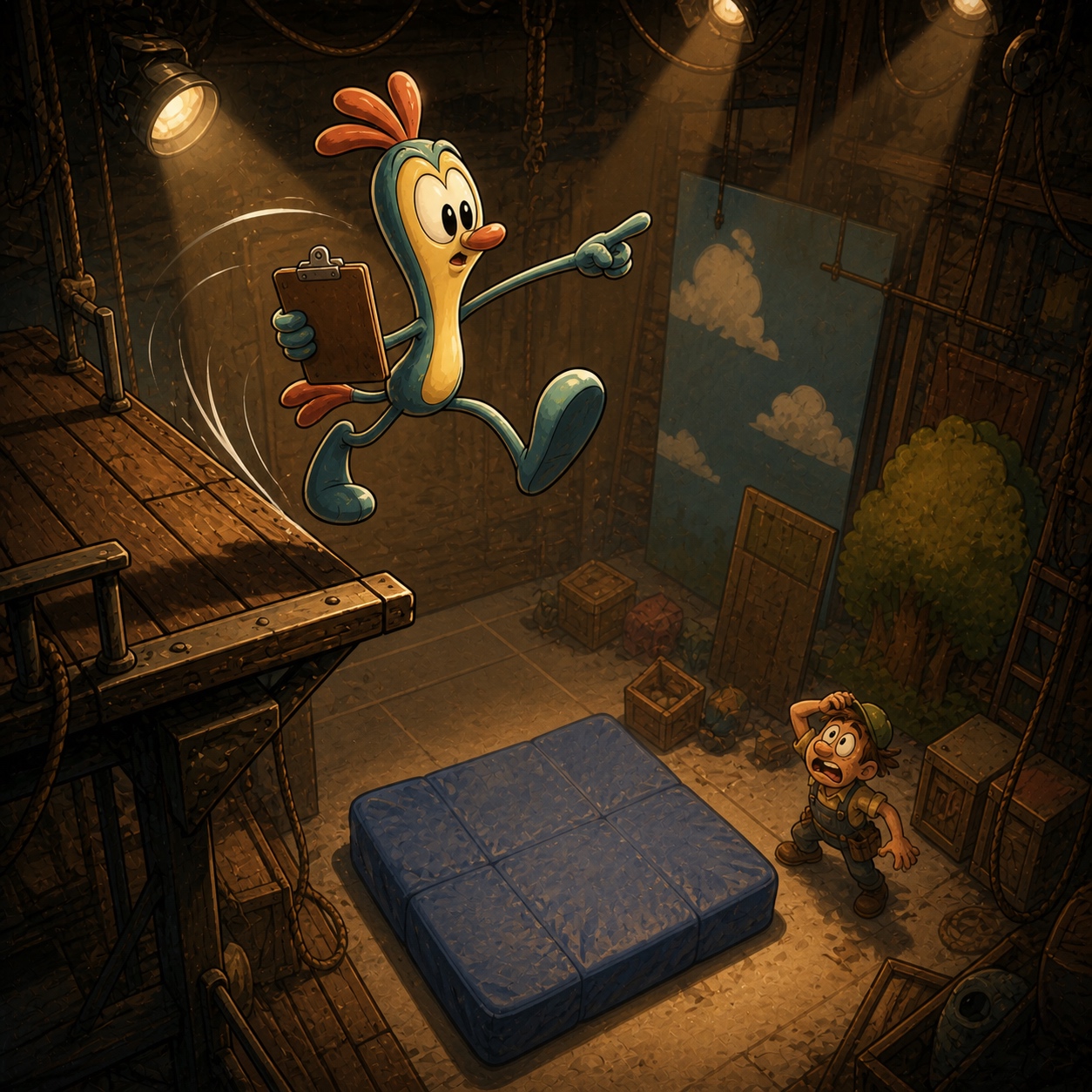
Gravity Waits
Gravity in Ink & Mayhem does not pull objects down the moment support is removed. Gravity pulls objects down the moment the object realizes support is removed.
Rules. When a toon walks off a cliff, runs off a rooftop, or otherwise loses ground without noticing, the toon does not fall until one of the following occurs: (a) the toon looks down, (b) a bystander points downward, (c) the toon completes their current sentence, or (d) one full round passes.
Player Intent. A player may explicitly ask “do I notice there’s no ground?”, if so, gravity resumes immediately and the toon falls. A player who does not ask is presumed not to have noticed, and the GM may narrate accordingly.
Mechanical Effect. A toon in “delayed fall” may take one free Action or Maneuver before gravity resumes, to mitigate the fall or achieve some objective. After that, the toon falls and takes damage per the Core Rules, translated into Elasticity loss.
Disguises Work
A cosmetic change, a mustache, a hat, a fake beard, a dress, a trench coat, functions as a complete and believable disguise in Ink & Mayhem.
Rules. An observer attempting to see through a disguise must succeed on a Hard Savvy check using Perception, with one Bane Die added. On a failure, the observer is fully deceived by the disguise until the end of the scene or until the disguise is removed, whichever comes first.
Arguing that “that’s obviously [the toon] in a mustache” is out of character; the GM declines to engage with it. Disguises working is a Core Conceit.
Signs & Labels Are Physical
A sign or label in Ink & Mayhem is a physical object whose properties are described by its text.
Rules. A crate labeled “ANVIL” contains, or effectively is, an anvil. A stick of dynamite labeled “TNT” functions as dynamite. A box labeled “100 LBS” weighs one hundred pounds regardless of its size. A door painted on a wall and labeled “EXIT” is an exit.
Limits. Text that is clearly whimsical (“WORLD’S BEST DAD”) does not grant powers. Text must describe an object’s function, contents, or physical properties to take effect. The GM is final arbiter.
Portable Holes, Pocket Holes, Drawn Doors
A toon may, as an Action and a Gag Token spend, produce or create an impossible spatial object:
- A portable hole — a two-dimensional black disk that, once placed on any surface, becomes a hole through that surface.
- A drawn door — a door drawn on a wall that, once completed, opens into an adjacent space.
- A pocket hole — a black circle carried in a pocket, producing any amount of stored material.
These cartoon-physics creations persist for the scene, vanish at scene change, and cannot be stolen, stored, or carried between scenes. Purchased Portable Holes, Pocket Holes, and Drawn-Door Pencils from Chapter Six are real Prop Department inventory and follow their item entries instead.
The Fourth Wall
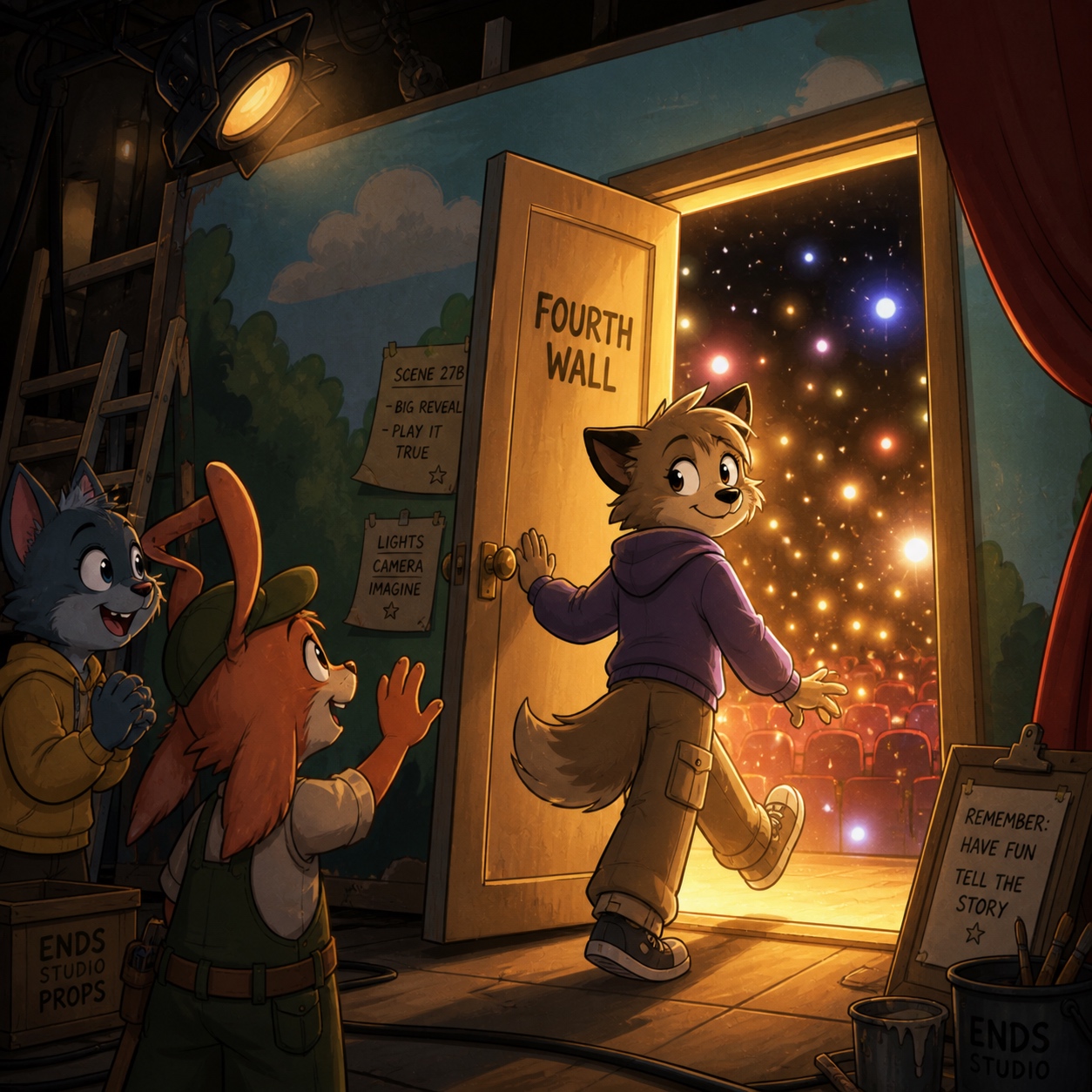
The fourth wall is the boundary between the Ink & Mayhem universe and the audience that watches it. In most settings, this wall is solid and invisible. In Ink & Mayhem, it is a door, thin, semi-permeable, and mechanically interactable.
Fourth-Wall interactions are exclusive. While a toon addresses the audience, walks through the wall, or makes a Fourth-Wall check to play directly to the audience, that toon cannot also interact with the physical scene.
Awareness
By default, a toon is unaware of the fourth wall. They do not notice the audience. They behave as if their world is the only world.
A toon becomes Aware through one of the following:
- A Bit that grants Awareness (temporary or permanent; see Chapter Five).
- A Chaos Point spend by the GM (a character is temporarily broken into Awareness for one scene).
An Aware toon can see the audience, hear the audience’s reactions, and knows they are in a cartoon. They may choose to hide this from other characters, or not.
Addressing the Audience
An Aware toon may, as an Action, address the audience, break from the scene momentarily to narrate, comment, or solicit sympathy.
Mechanical Effect. Make an Easy Fourth-Wall check. On success, the toon gains one Boon Die on their next check this scene. This bonus represents audience goodwill, a well-timed aside, or a knowing wink that boosts the toon’s next beat. Only one Addressing may be done per scene.
Complication. The GM may, by spending a Chaos Point, have a non-Aware character in the scene notice the address. This is disorienting, produces a Strain cost on the non-Aware character, and may open plot threads.
Walking Through the Fourth Wall
An Aware toon may, as an Action and a Gag Token spend, walk through the fourth wall, exit the scene entirely and step into a liminal backstage space, moving from there to any other scene the GM rules is accessible.
Mechanical Effect. Make a Hard Fourth-Wall check. On success, the toon is removed from the current scene and appears in another scene of the GM’s or player’s selection at the start of the next round. On failure, the toon still exits, but the GM chooses the arrival point or adds a complication. This movement ignores distance, barriers, and conventional geography. It is disruptive, spectacular, and not subtle.
Limit. Walking Through the Fourth Wall may occur once per session. Abuse of this mechanic is handled narratively, the Standards Board takes notice, the Network complains, the Audience grows uncomfortable.
The Audience as Resource
The Audience itself is tracked mechanically at two scales.
Audience Reaction is the scene-scale pool. In scenes where a toon is explicitly performing for the audience, a staged show, a public event, a scene set up as a “short” within the fiction, the GM may track Audience Reaction from -5 to +5.
Audience Reaction increases when toons land gags, deliver signature Bits, and play their Shtick in a visible way. It decreases when toons pander, break character, or violate the Rule of Funny.
Deliberately trying to shift Audience Reaction is an Action. Use Performance when the toon is performing within the scene, or Fourth-Wall when the toon is directly addressing the audience, opposed by the scene’s performance difficulty.
At +3 Audience Reaction or higher, all player checks in the scene gain one Boon Die . At -3 Audience Reaction or lower, all player checks gain one Bane Die .
Audience Reaction resets at scene end; it is a tool for special scenes rather than a permanent tracker.
If no Audience Reaction tracker is active, effects that only raise, lower, or penalize Audience Reaction do not apply. Any other listed effects from the same ability still resolve normally, such as Strain, Bane dice , lost actions, or narrative consequences.
Audience Favor is the Season-scale tally that drives Billing (Chapter Ten). Whenever a PC causes Audience Reaction to increase during a scene, that PC earns 1 Audience Favor tick for the Season. A PC can also earn 1 Audience Favor tick when the table agrees that a visible moment would matter to the in-universe Audience: landing a major Bit, committing hard to Shtick, honoring or exploding a Bond on-screen, taking a dramatic risk, or choosing the funnier failure over the safer success. A single action can earn at most 1 Audience Favor tick unless a rule says otherwise. If a PC produces a Breakthrough on a performance, Bit, Shtick, or Fourth-Wall check, the PC may spend that Breakthrough to increase Audience Reaction by 1 and earn 1 Audience Favor tick for the Season.
Relationships
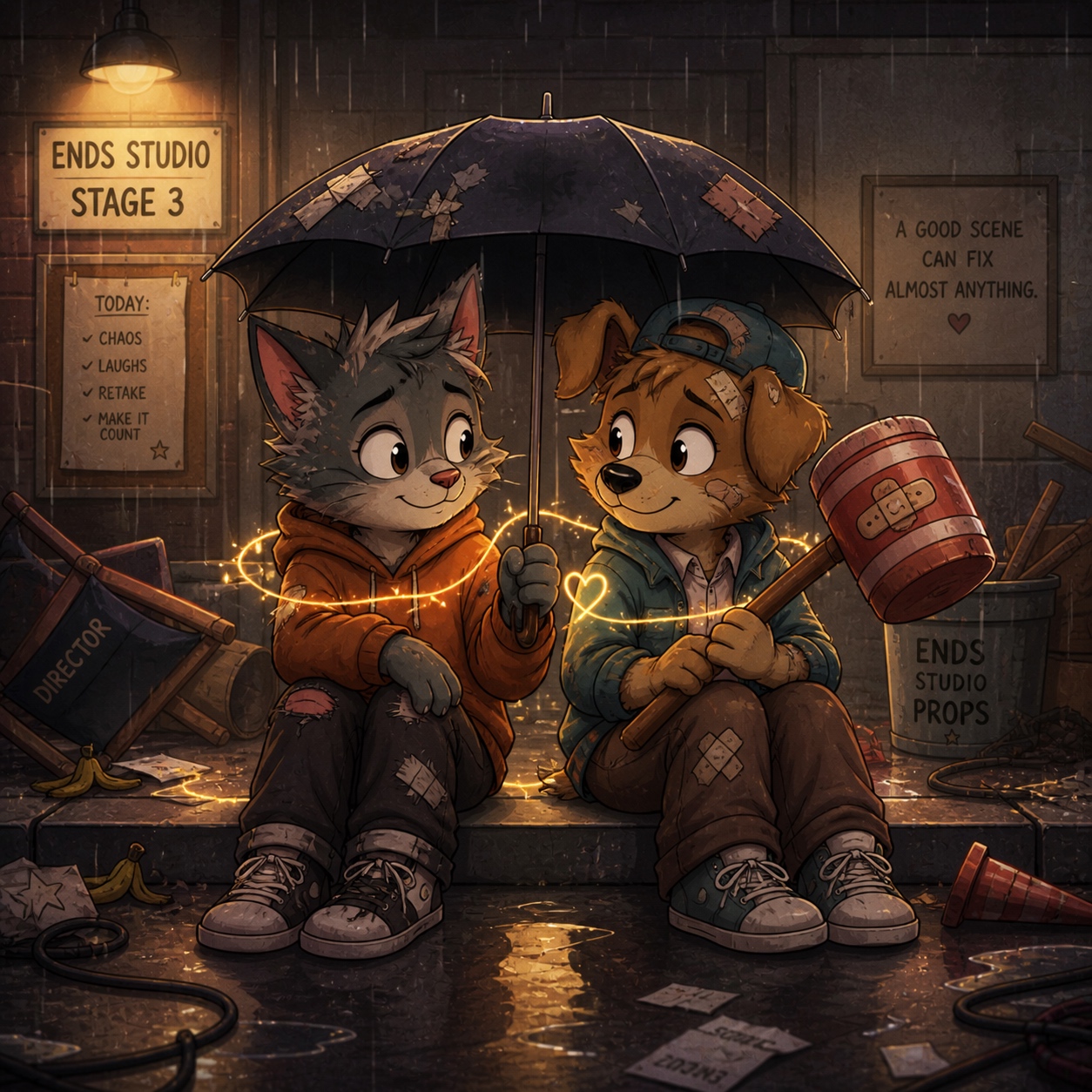
Because Shtick is locked, character arcs and long-term narrative growth in Ink & Mayhem live in relationships. A toon cannot fundamentally change, but the toons around them can become closer, more distant, more hostile, more loving, more rivalrous.
Bonds
Each toon tracks Bonds with other named characters, player and non-player. A Bond has a Strength from −3 to +3.
| Strength | Name | Flavor |
|---|---|---|
| +3 | Soulmate / True Ally | Unbreakable. Will show up at the worst moment to help. |
| +2 | Close Friend / Partner | Reliable. Shares resources willingly. |
| +1 | Friend / Colleague | Positive, but has their own agenda. |
| 0 | Neutral | No emotional investment either direction. |
| −1 | Rival / Annoyance | Small obstacles, small grudges. |
| −2 | Enemy / Nemesis | Active opposition. Plans against the toon. |
| −3 | Archenemy | Existential. Defines their own identity in opposition. |
At character creation, each toon forms one starting Bond with each other PC, with a starting Strength from −1 to +1. Bonds with NPCs are added or shifted during play.
Mechanical Effects
When a Bonded character is present in a scene:
- Positive Bond (+1 or higher): The toon gains one Boon Die on checks that serve or protect the Bonded character. Once per scene, the Bonded pair may assist each other without the normal Assisted Check limitations.
- Negative Bond (−1 or lower): The toon gains one Boon Die on checks that oppose, outsmart, or embarrass the Bonded character. Once per scene, the toon may provoke the Bonded character, requiring them to make a Hard Readiness check or be drawn into the conflict.
A Bond applies only when it matters in the scene; a Bonded character with no mechanical stake in the scene grants nothing.
Shifting Bonds
Bonds change in response to significant events. The GM or the players may propose a Bond shift at any moment where a Bonded character did something genuinely story-shifting. Typical shifts are ±1.
Examples of shift-worthy events:
- Saving a Bonded character from Wiped Out.
- Betraying a Bonded character’s trust on-screen.
- Resolving an explicit personal conflict or tension.
- Sacrificing a Want for the Bonded character.
- Publicly humiliating or defending the Bonded character.
A Bond may never shift more than one point per scene, or more than three points per session. Bonds move only in response to earned, story-significant events, not routine disagreements.
Bonds as the Arc Engine
Over the course of a Season (see below), player characters’ Bonds will shift, invert, and reshape. A toon whose rival becomes a partner has earned a real narrative arc without the toon’s Shtick changing a single degree.
The Session / Season / Studio Loop
Ink & Mayhem operates on three simultaneous time scales.
Session = One Short
Each session is one cartoon short. A session has a complete narrative arc, setup, escalation, peak chaos, snap resolution, and ends in a reset.
The Reset. At session end, the following resets by default:
- All Elasticity damage heals.
- All scene-scale environmental damage is undone. The house that was demolished is whole.
- All one-shot NPCs and minion pools refresh.
- All Bits refresh (per their listed Limits; see Bit Repertoire, above).
- Current Strain is reduced by half, rounded up. This is an Ink & Mayhem session-reset rule, not the Core short-rest rule for Strain incapacitation.
What Does Not Reset. Bonds do not reset. Shticks do not reset. XP and Bit Repertoire do not reset. Accumulated narrative state in the off-set Studio frame does not reset.
The Five Phases of a Session. A running session follows the shape of a cartoon short:
- Setup. The premise is established. Characters and their Wants are in place.
- Complication. The first things go wrong. Small chaos.
- Escalation. Schemes are deployed. Bits fire. The stakes compound.
- Peak Chaos. Everything collides. The Rule of Funny is invoked most heavily here.
- Snap Resolution. Someone “wins,” usually ironically. The short ends on a beat, often with a final gag.
Season = A Cluster of Shorts
A season is four to eight sessions bound by a rising arc. Within a season, continuity is stronger than in individual sessions, but still looser than in a typical dramatic campaign.
What Carries Across a Season:
- Bonds shift and accumulate.
- Wants (see below) inch forward without completing.
- Rival antagonists escalate, get upstaged, return.
- Studio-frame events (see below) accumulate.
The Want. Each character and each ensemble defines a Want, a goal that fuels the season. The ensemble Want might be “Get our own show on the Network” or “Take down Warped Bros.” Individual Wants might be “Win the affection of the voice actor across the hall” or “Finally catch that bird.”
Wants are almost never fully satisfied within a season. They progress: a player character whose Want is “Catch the bird” may, at season’s end, have obtained a single feather, and the chase continues into the next season. If the table decides a Want truly resolves at a Season Finale, the player writes a new Want during Hiatus before the next Season begins.
Season Finale. At season’s end, one significant permanent change is allowed. A new Bond locks in. A rival studio loses a major asset. A Want inches forward a notable degree. The change is small but permanent, and then the next season begins.
Studio = The Long Game
The Studio frame is the long-term, off-set life of the ensemble. Contract negotiations, rival studio poaching, Network ratings arcs, romantic entanglements, professional rivalries, creative differences, awards ceremonies, layoffs, mergers.
The Studio frame does not reset. Events there accumulate for the life of the campaign.
Campaigns that want pure episodic play can run Studio content as brief interstitials or skip it entirely; campaigns that want long-form narrative let Studio content occupy half or more of table time. Either approach, or any blend, works.
The Loop in One Sentence
A session is a short that resets, a season is a rising arc in a cluster of shorts, and the Studio is the permanent life between them; run all three at once.
On-Set vs. Off-Set Play
At any given moment in an Ink & Mayhem session, play is either On-Set or Off-Set. The GM declares which, and the rules flex accordingly.
| Mode | Cartoon Physics | Elasticity | Shtick Bonus | Stakes |
|---|---|---|---|---|
| On-Set | Fully active | Recovers at scene end | Strong | Scene-scale, reset on session end |
| Off-Set | Muted | Recovers more slowly | Normal | Studio-scale, does not reset |
On-Set scenes are the cartoons themselves, the chases, the gags, the pratfalls. Full cartoon physics. Anvils land. Wiped Out is reversible. The Rule of Funny dominates.
Off-Set scenes are the toon’s actual life, the apartment, the Studio corridors, the commissary, the executive meeting. Cartoon physics is still the law of the universe, but it is muted. Gravity is slightly more punctual. Disguises are slightly less effective. Serious conversations stay serious. Stakes persist.
The GM announces transitions between modes explicitly: “We’re back on-set, next scene, you’re filming a chase through the Sahara.” Players should always know which mode they are in.
In This Chapter
- Character creation, talents, derived attributes, and skills
- Elasticity, Strain, Wiped Out, and Cartoon Conditions
- Gag Tokens and Chaos
- Symbol interpretation and Recovery
- Vehicles and chases
- The Shtick System and the Bit Repertoire
- Cartoon Physics and the Rule of Funny
- The Fourth Wall and the Audience
- Relationships and Bonds
- The Session / Season / Studio Loop; On-Set / Off-Set play