PDF Download the Ink & Mayhem Universe Guide 24.0 MB
The antagonists of Ink & Mayhem are not evil. They are employed elsewhere. The Warped Bros. pie-thrower who dropped an anvil on your head last week will be dropping another one next week, and a third the week after that, and at the end of the season you and he will share a cigarette behind the commissary and complain about the craft services. The Standards Board censor who flagged your entire last short is hoping you will send his daughter an autograph. The executive at the Network who canceled your show is quietly trying to get you your own deal at another Network. This is the business. Every adversary in this chapter is still, at heart, a colleague. They are just in your way right now.
How to Use This Chapter
Every adversary in Ink & Mayhem follows the standard Exodus NDS tier structure: Minions (grouped pools), Elites (named mid-tier opponents), and Nemeses (signature antagonists). The stat blocks below use the Core Rules conventions with two setting-wide substitutions: the Wound track listed on each stat block is Elasticity in Ink & Mayhem, not standard Wounds, and adversaries do not suffer Critical Injuries. Elasticity recovers at the end of each scene in the same manner as PC Elasticity (Chapter Eight), and the Wiped Out condition applies. Elites and Nemeses can still be hit by Perfect Cartoon Moments; they are Wiped Out instead of rolling on a Critical Injury table.
Most adversaries in this chapter return next scene, next short, or next session regardless of outcome. Nemeses specifically are intended to recur: any given session may see the Nemesis flattened, exploded, launched into orbit, or folded into an accordion, and the next session they will be sitting at their desk again, uninjured and thinking about next week’s short. The only way a Nemesis is retired is through explicit narrative commitment, a Season or Studio-level arc resolution (Chapter Ten).
A Note on Opponents with Shticks
NPCs in Ink & Mayhem often have Shticks. When an adversary’s stat block notes Shtick: [description], that NPC operates under the same In-Shtick / Against-Shtick rules as a PC (Chapter Eight). Give every named rival a one-sentence Shtick.
Minions
A Minion group acts as a single entity, sharing one pool and making one check per round; each group’s trained skills and their ratings are listed in its stat block. The Wound value printed in each Minion stat block is per Minion; the group’s shared pool equals that value multiplied by the number of Minions in the group.
Warped Bros. Pie Squad (Minion)
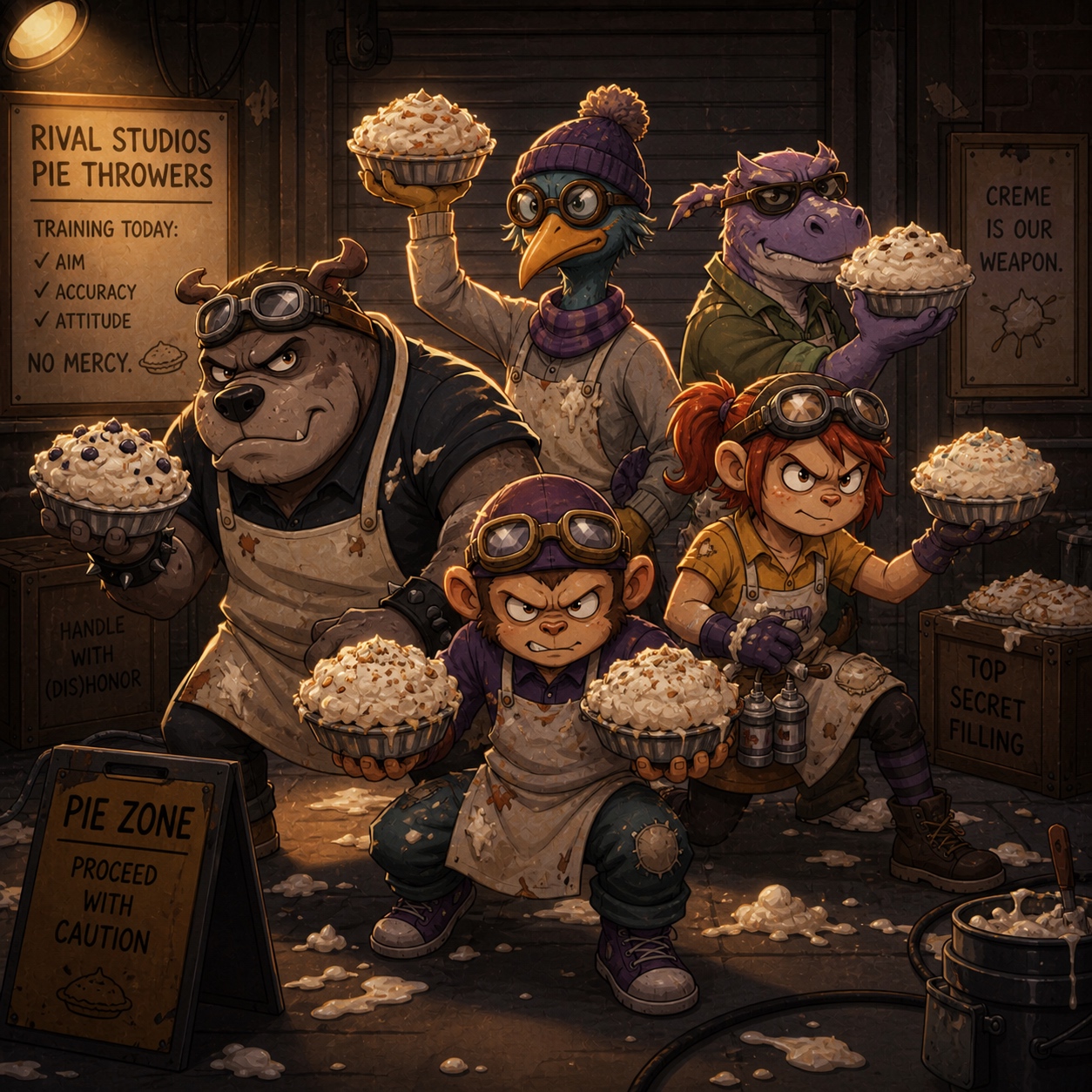
- Group Size: 3–6
- Skills: (group only) Ranged 2, Brawl 1, Coordination 1
- Abilities: Pie Barrage, The group may make a single coordinated Ranged attack (pies) against all engaged characters; targets struck gain Blind 1.
- Equipment: Pies (dozen per squaddie), striped Warped Bros. coveralls, one harmonica.
Mice House Security (Minion)
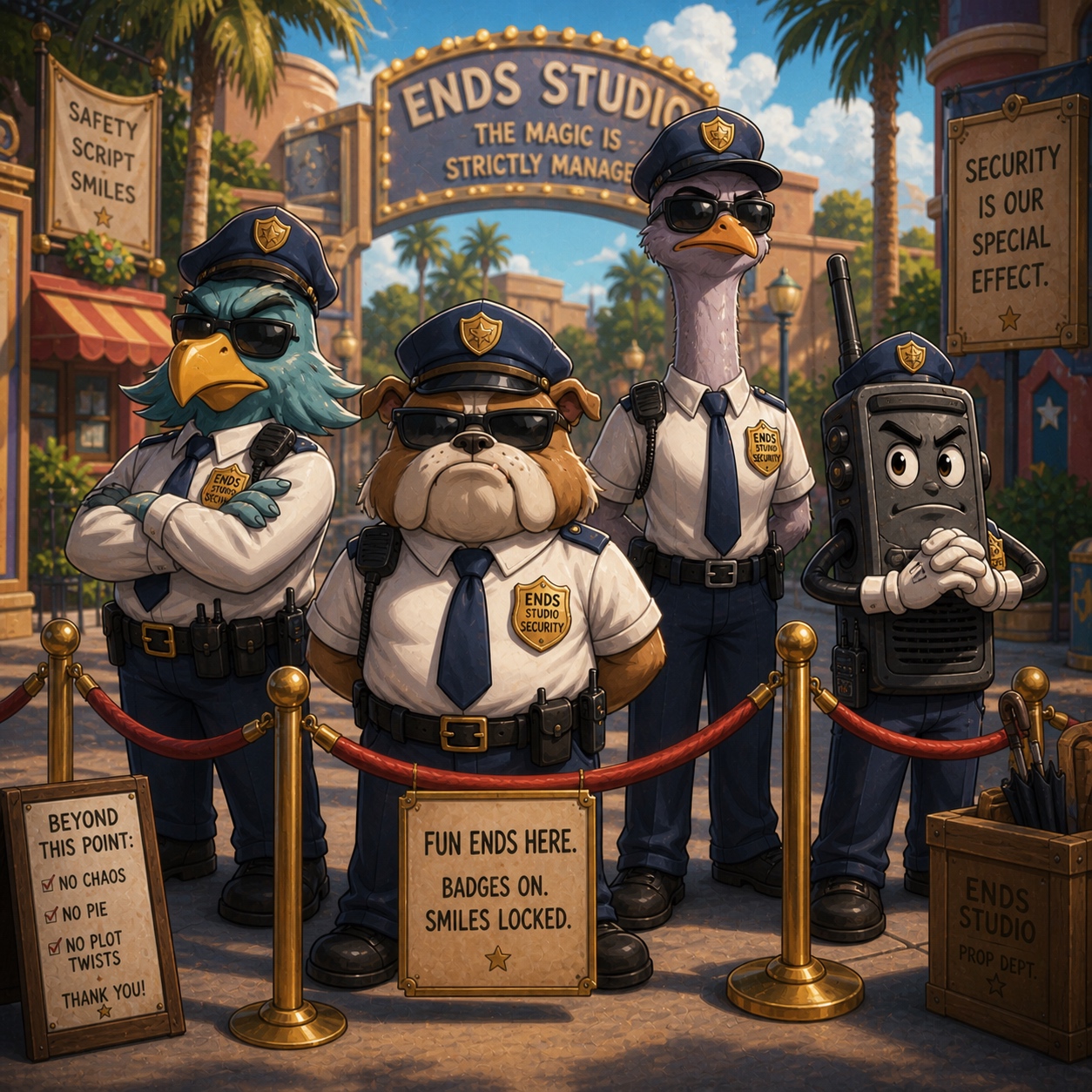
- Group Size: 3–6
- Skills: (group only) Brawl 2, Perception 2, Streetwise 1
- Abilities: Escort Off-Lot, On any successful grab, the group may immediately move the grabbed target one zone toward the lot exit.
- Equipment: Uniforms, nightsticks (Melee +2), radios, badges with an uncanny corporate mascot.
Standards Board Clerks (Minion)
- Group Size: 2–4
- Skills: (group only) Lore 2, Perception 2, Negotiation 1
- Abilities: Flag the Gag, As an action, the group may flag any gag being performed in the scene. The flagged character’s next check takes 1 Bane die ; the flag may be contested with a Hard Negotiation check.
- Equipment: Clipboards, identical gray suits, red rubber stamps, the entire Studio Code of Practice in four volumes.
Hostile Press Pool (Minion)
- Group Size: 3–6
- Skills: (group only) Streetwise 2, Perception 2, Deception 1
- Abilities: Bad Headline, As an action, the group may compose a ruinous headline about one named PC. If an Audience Reaction tracker is active, that PC reduces the next check they make to shift Audience Reaction by 1. Either way, they take 3 Strain as they read the morning paper.
- Equipment: Notepads, cameras with exploding flashbulbs, fedoras (one each), a collective grudge.
Studio Lawyer Team (Minion)
- Group Size: 2–4
- Skills: (group only) Negotiation 2, Deception 2, Lore 1
- Abilities: Cease and Desist, As an action, the group may serve one character with legal papers. That character may not use one named Bit for the remainder of the scene; the papers can be torn up with a Hard Negotiation check.
- Equipment: Briefcases, pinstripe suits, a document that would ruin you if you read it.
Stagehand Gang (Minion)
- Group Size: 3–6
- Skills: (group only) Brawl 2, Melee 2, Athletics 1
- Abilities: Drop the Set, Once per scene, the group may collapse part of the set on a target (Ranged attack, Damage 6, Blast 2, Cumbersome).
- Equipment: Prop mallets (Melee +3), stage weights, the keys to the flyloft.
Elites
Elites use individual stat blocks. Most have a Shtick and a handful of Bits.
Rival Toon (Elite)
Generic mid-tier cartoon antagonist, reskin with an appropriate name, Look, and studio.
- Shtick: Variable, pick one from Chapter Three to match the role.
- Skills: Brawl 2, Ranged 2, Coordination 3, Pratfall 2, Gag-Craft 2, Streetwise 2.
- Talents: Character Voice, Comic Timing.
- Bits: Two, chosen to match the Shtick.
- Equipment: One signature weapon (Frying Pan, Stick of Dynamite, or Pie), disguise kit, pocket of nickels.
Studio Executive (Elite)
- Shtick: “Notes, notes, notes.”
- Skills: Negotiation 3, Deception 3, Leadership 2, Lore 2, Streetwise 3.
- Talents: Contract Renegotiation.
- Abilities: Give Notes, As an action, deliver ninety seconds of notes on a PC’s performance. The PC takes 3 Strain and loses their next Maneuver as they process the critique.
- Equipment: A suit cut for a different man, cigar, the only copy of the Season Budget.
Censor Inspector (Elite)
-
Shtick: “Somebody has to say no.”
-
Skills: Lore 3, Perception 3, Deception 2, Negotiation 2.
-
Bits: Unbreakable Composure.
-
Abilities: Red Stamp, As an action, officially flag a gag in progress. The performing PC cannot spend a Breakthrough on the flagged check to increase Audience Reaction or earn the linked Audience Favor tick. One flag per scene per Inspector.
-
Equipment: Standards Board badge, a red stamp worn smooth from use, complete annotated Code of Practice, an umbrella they never open.
Pie Squad Captain (Elite)
- Shtick: “I take pie delivery very seriously.”
- Skills: Brawl 3, Ranged 3, Coordination 2, Leadership 2, Streetwise 2.
- Talents: In Character (as the talent, applied to Shtick).
- Bits: Pocket Dynamite, Crash the Scene.
- Equipment: Pie carousel harness (carries 30 pies), chauffeur’s cap, a whistle that summons the Pie Squad.
Bounty Toon (Elite)
- Shtick: “You owe someone. I am the someone.”
- Skills: Ranged 3, Stealth 3, Streetwise 3, Perception 2, Deception 2.
- Talents: Comic Timing.
- Bits: Improvised Booby Trap, No Brakes.
- Equipment: Comedy Musket, bear trap, photograph of the mark with a red X drawn through it.
Prop Department Rogue (Elite)
A former Prop Department staffer who went freelance. Knows every tab, every secret, every trick.
- Shtick: “Every prop has a history. Especially yours.”
- Skills: Craft 3, Streetwise 3, Gag-Craft 3, Deception 2.
- Talents: Sign Painter, Hammerspace Expert.
- Abilities: Your Tab, As an action, the Rogue reveals to a PC an embarrassing charge from their Tab. The PC takes 3 Strain and Audience Reaction drops by 1 this scene.
- Equipment: Master key to the Prop Department, every portable hole ever made, a ledger older than anyone living.
Nemeses
Nemeses use full stat blocks, with Strain tracked separately, and recur until retired (see How to Use This Chapter).
Bitsy Malone (Nemesis)
Former ENDS co-star, current Warped Bros. headliner, rival of the ensemble. Looks like a rabbit, if the rabbit had a Broadway contract.
- Shtick: “I used to work here. Now I’m better.”
- Skills: Charm 4, Deception 3, Performance 4, Brawl 2, Gag-Craft 3, Streetwise 3, Fourth-Wall 3.
- Talents: In Character, Star Power, Character Voice.
- Bits: Sudden Musical Number, Steal the Scene, Ham It Up, To the Camera, Audience Eyes, Last-Second Monologue.
- Abilities: Old Friends, Bitsy starts every scene with +1 Bond with the PC she was once closest to (table picks at the first encounter). The Bond operates normally from then on and can be used in both directions.
- Equipment: Custom Warped Bros. contract in her pocket, a rose (red), a photograph of the ensemble with her face cut out.
The Executive (Nemesis)
A nervous man in an ill-fitting suit. The Network’s embodied presence on the lot. Has no first name; everyone calls him “the Executive.” No one knows whom he reports to.
- Shtick: “The Network is very concerned.”
- Skills: Negotiation 4, Deception 4, Streetwise 4, Lore 3, Leadership 3.
- Talents: Contract Renegotiation, Character Voice.
- Abilities: The Network Is Concerned, Once per session, the Executive may declare a ruling on a PC’s performance that overrides the GM’s scene resolution. The Network’s ruling is final. The PC may buy off the ruling with a Gag Token spent before the scene ends.
- Abilities: Clipboard, Anyone looking at the Executive’s clipboard suffers 1 Strain and learns one fact about their own contract they wish they did not know.
- Equipment: Ill-fitting suit (three sizes too large), clipboard, pen that runs out of ink at dramatic moments, a beeper that goes off once per scene.
J. Lemington Crust (Nemesis)
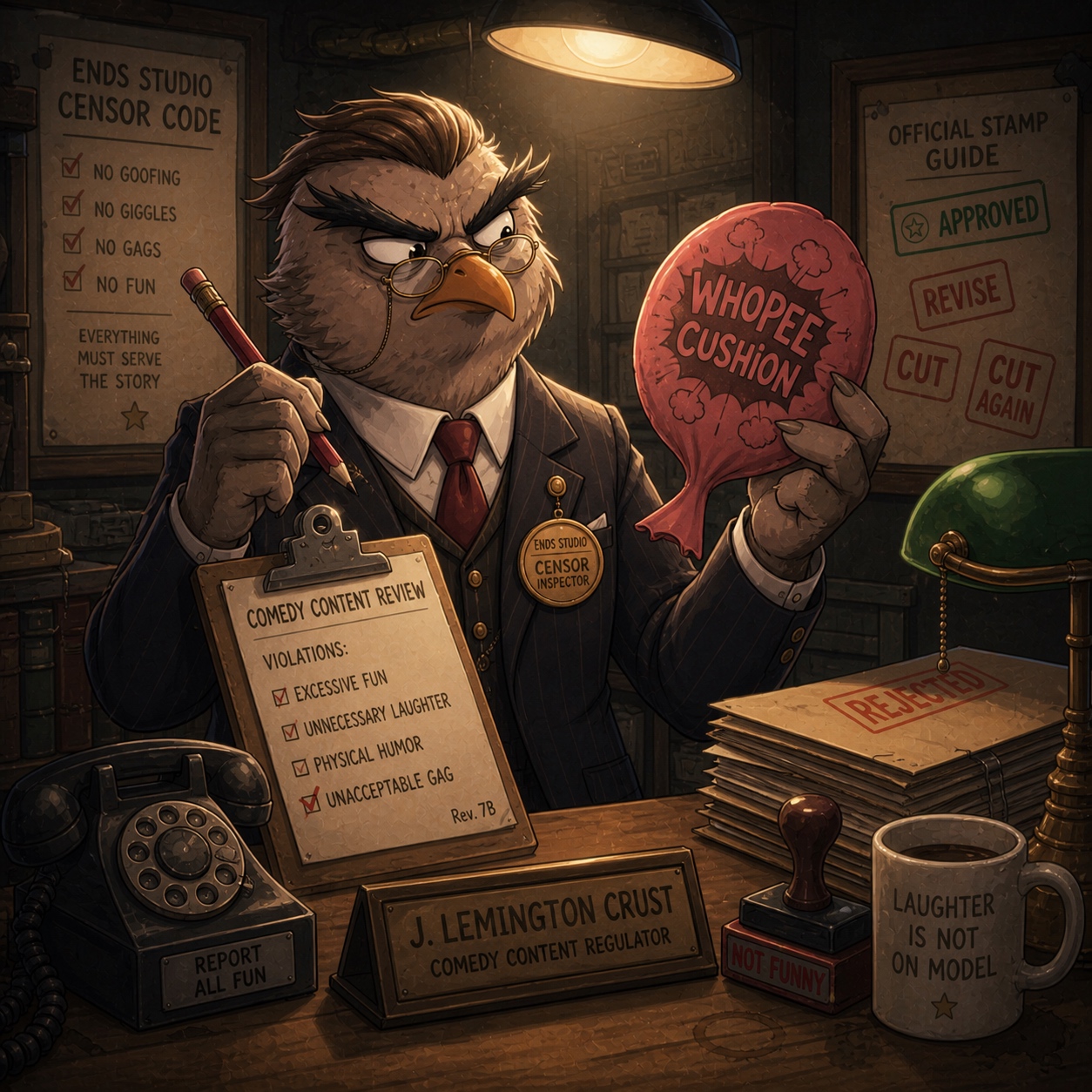
Chief Censor of the Standards Board. Reviews every short ENDS produces. Has never laughed out loud on the job.
-
Shtick: “I protect the audience from themselves.”
-
Skills: Lore 4, Perception 4, Negotiation 3, Leadership 3.
-
Bits: Unbreakable Composure.
-
Talents: Comic Timing (yes, the censor has timing), In Character.
-
Abilities: Executive Veto, Once per session, Crust may cancel a gag entirely. The performing PC loses the action; the action’s equipment is consumed; no Elasticity damage is resolved on any target of that action. Opposed by Hard Negotiation or a spent Gag Token (which Crust may oppose with Willpower). If the cancelled gag had already been rolled, any Calamity from that roll still resolves.
-
Abilities: The Red Stamp, All Minion Standards Board Clerks within Long range of Crust operate at +1 to their group skill rating.
-
Equipment: Leather-bound Code of Practice, gold rubber stamp (red ink, always red), reading glasses, a single monochrome photograph of himself laughing as a child (hidden).
Old Patches (Nemesis)
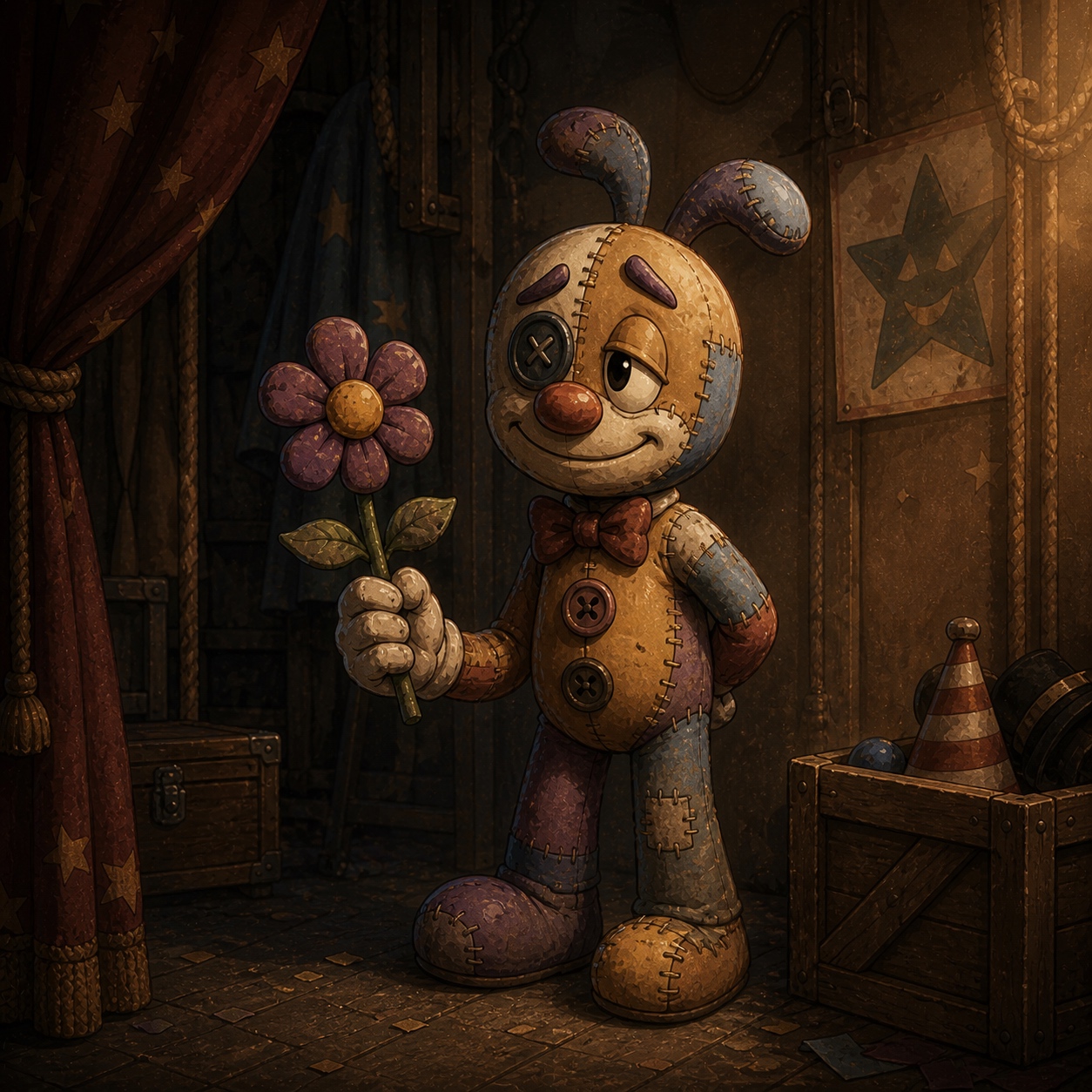
A veteran toon, former Golden Age star, retired and then un-retired into rival work. Looks like a patchwork cat, because he has been repaired so many times. Former close friend of the oldest PC, if any qualifies.
- Shtick: “I did this bit before any of you were drawn.”
- Skills: Brawl 3, Melee 3, Gag-Craft 4, Pratfall 4, Lore 4, Streetwise 3, Fourth-Wall 3.
- Talents: Committed to the Bit, Bit Virtuoso, Shtick Hero.
- Bits: Deadpan Reaction, Gadget That Only Works Once, Last-Second Monologue, Anvil Magnet, Expert Testimony, Audience Eyes. (Full 6-slot Repertoire.)
- Abilities: Seen It All, Old Patches is immune to all surprise and ambush effects.
- Abilities: The Old Bits Work Best, On any Breakthrough, Patches may re-use an already-spent Bit this scene.
- Equipment: A walking stick that is also a rolling pin, a hand-stitched coat full of patches, half a bottle of studio whiskey.
The Cataclysm Kid (Nemesis)
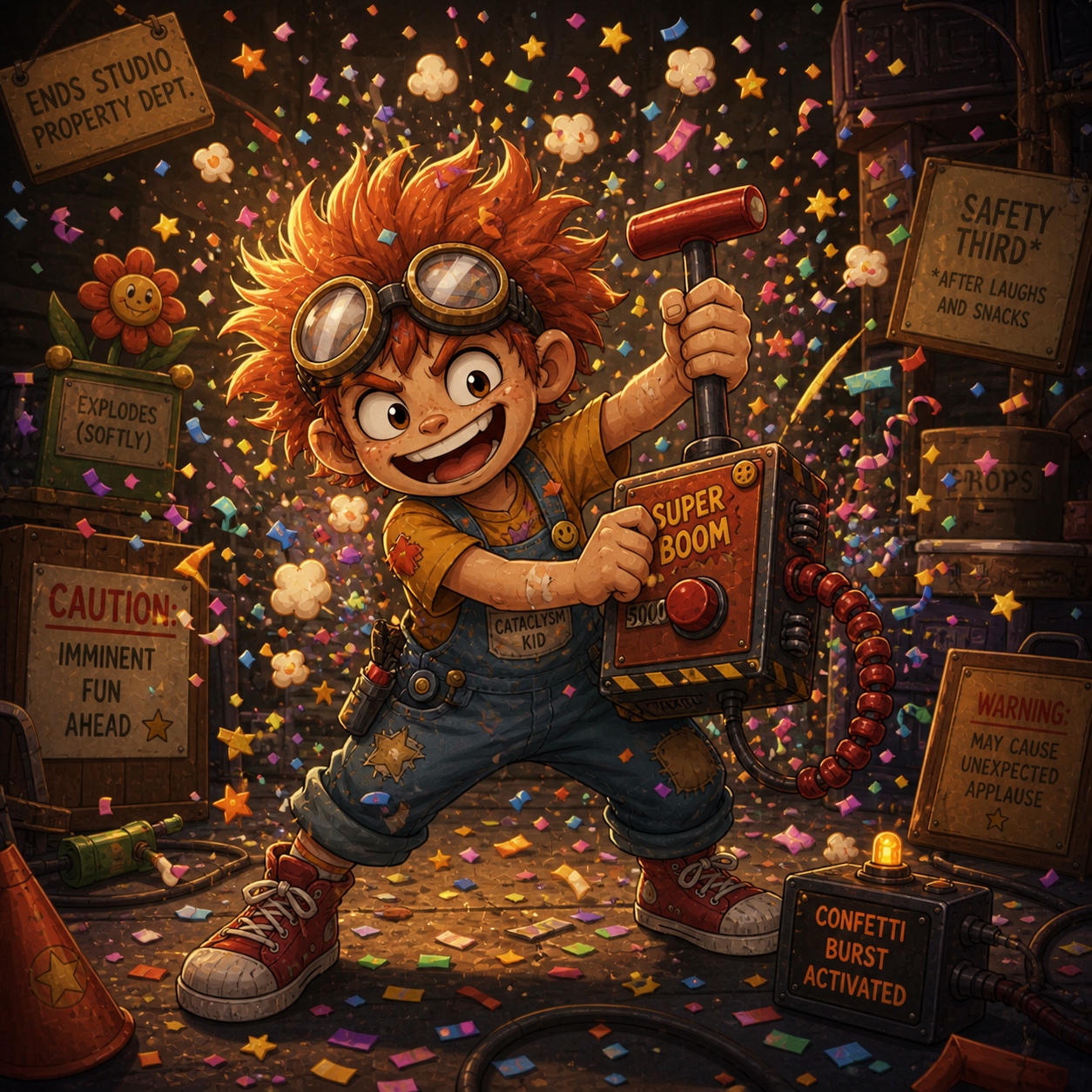
A young, unhinged, rising Warped Bros. star. Loose Cannon archetype with a cruel streak. Views the ensemble as furniture to throw at cameras.
- Shtick: “I break everything I love.”
- Skills: Brawl 4, Ranged 3, Athletics 3, Pratfall 3, Streetwise 2, Deception 2.
- Talents: Unbreakable, Comic Timing, In Character.
- Bits: Pocket Dynamite, Crash the Scene, No Brakes, Collateral Damage.
- Abilities: Escalation, Each round the Kid remains in a scene, the scene’s property damage cost escalates by 50 PC. This bill is always paid by ENDS.
- Abilities: Audience Loves a Villain, When a PC fails a check against the Kid, Audience Reaction drops by 1 for the PCs, to a minimum of -5.
- Equipment: Twin dynamite bandoliers, rocket-propelled skates (always on fire), a matching set of punch-out gloves, a grudge he cannot articulate.
Penelope “Penny” Periwinkle (Nemesis)
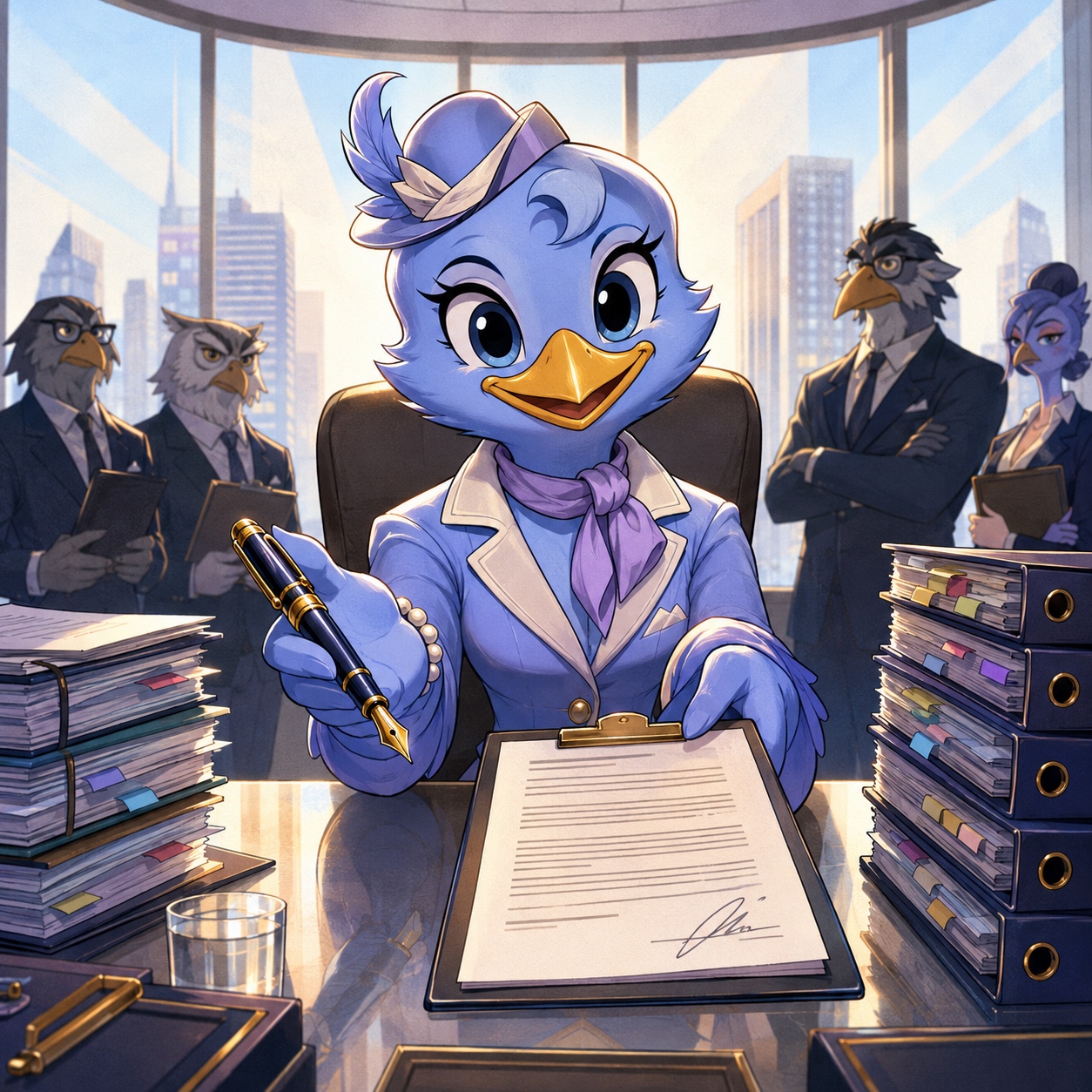
The face of Mice House Entertainment. A periwinkle-blue songbird mascot, beak permanently shaped into a pleasant smile, wings folded over a clipboard. Has not been seen out of costume in twenty-three years. Owns more of the studio system than anyone alive will publicly admit. Speaks only in approved phrases. Sues, gently, in the third person.
- Shtick: “I would love to help you with that, please sign here.”
- Skills: Charm 4, Negotiation 4, Deception 3, Lore 3, Performance 3, Fourth-Wall 2, Subterfuge 2.
- Talents: Committed to the Bit, In Character, Bit Virtuoso, Star Power.
- Bits: Full Regalia, Professional Courtesy, The Monologue Is the Point, Sincere Question, Big Hug, Steal the Scene. (Full 6-slot Repertoire.)
- Abilities: The Smile Never Drops, Penny is immune to Strain damage, Rattled, Drenched, and any condition that would cause her to break character. The mascot stays on no matter what hits it. Inside the costume (if any toon ever proves there is anyone inside the costume) is a separate matter the Standards Board has ruled out of scope.
- Abilities: Always-On Counsel, Once per scene, Penny may produce a Mice House attorney from off-camera as a Quick Action. The attorney becomes a Studio Lawyer Team (Minion group, see this chapter) instantly engaged with the PC who upset her. The attorney does not require travel time, advance notice, or a logical entrance.
- Abilities: Brand Compliance, When a PC speaks Penny’s name, a corporate trademark, or any approved Mice House phrase aloud, Penny may spend 1 Chaos Point as a free reaction to add 1 Bane die to that PC’s next check. Once per scene per PC in the group, minimum three times per scene total, regardless of how many trademarks are name-dropped. The PCs do not need to know which phrases are trademarked for this to trigger.
- Abilities: The Periwinkle Settlement, Once per session, in lieu of pursuing a PC further, Penny may offer a contract: the PC drops the current pursuit and gains 1 Gag Token immediately, but Penny adds 1 to the PC’s Standards Watch tally and shifts their Bond with Penny by −1. The contract is, of course, ironclad.
- Equipment: A clipboard that always has the relevant paperwork pre-filled, a fountain pen worth more than ENDS, a song-cue device that triggers an unprovoked musical number, a smile.
- Want: Acquire ENDS, quietly, paragraph by paragraph, until the toons wake up one Monday and realize the lot is a Mice House subsidiary. She is rich enough to do it. The only thing slowing her is taste, and she does not lack taste.
Running Penny
Penny is the Bitsy Malone of Mice House, but where Bitsy is loud, brassy, and direct, Penny is the soft no. Bitsy throws pies. Penny issues cease-and-desists wrapped in a thank-you card. The two are not interchangeable: a session that uses both should let Bitsy threaten the PCs physically and Penny threaten them legally and reputationally. Penny rarely appears in person; she sends representatives, paperwork, and offers. When she does appear, treat it as a season-level event and frame the scene as a meeting in a conference room with too much natural light.
The lawyer-safe edge: Penny is a parody of the corporate-mascot apparatus, not of any specific real-world character. Keep her grounded in contracts, brand management, and acquisition, the things parody and satire protect. Avoid props, trade dress, or songs that point at one specific real-world brand.
Environmental Threats
Some threats in Ink & Mayhem are situations rather than characters: the cartoon equivalents of terrain, traps, and hazards. These resolve through checks rather than stat blocks. Where a threat deals Elasticity damage, a hit character may use the Pratfall damage-reduction rule.
Anvil Deployment
Trigger: GM spends 1 Chaos Point, or a scene’s tension peaks in a way the GM judges deserves a falling object. Effect: An anvil (or piano, or safe) falls on a named target. The target rolls Hard Perception or Coordination to dodge; on success, they take no damage. On failure, they are hit for 4 Elasticity damage (Blast 1 for adjacent targets). Targets with the Anvil Magnet Bit take the hit regardless and receive its benefit.
Set Collapse
Trigger: GM spends 2 Chaos Points, or a wall/ceiling/flat has been hit by enough Calamity results to give way. Effect: A segment of the set falls. All characters in the affected zone roll Hard Athletics or Coordination to escape the collapse; on failure, they take 4 Elasticity damage and are knocked prone. The zone becomes difficult terrain for the rest of the scene.
Sprinkler System
Trigger: Any fire in the scene lasting longer than one round, or a pulled fire alarm. Effect: All characters in the affected building become Drenched, adding 1 Bane die to all Coordination checks for the remainder of the scene. Smoke Bombs and similar obscuring effects are cleared. All dynamite in the scene becomes inert until dried.
Hostile Script Rewrite
Trigger: Plot-scale GM action. May be invoked once per session at most. Effect: The narrator briefly changes the script. One established fact of the scene changes, a door that was locked is now open, a weapon in a PC’s hand becomes a banana, a sealed room now has a window. PCs with Narrative Override (Chapter Five) may contest the rewrite immediately.
Audience Boos
Trigger: A performance scene where PCs fail Performance or Fourth-Wall checks spectacularly. Effect: The audience boos. Audience Reaction drops by 3, to a minimum of -5. All PCs in the scene take 3 Strain and suffer 1 Bane die on their next check. Audience Reaction resets next scene per Chapter Eight.
Flagged by the Standards Board
Trigger: A gag deemed “too much” by the GM (or by a Censor Inspector in the scene). Effect: The gag’s action still resolves, but the Breakthrough effect (if any) is canceled. The gag goes on record. Three flags on one PC in a single Season triggers a contract review with Crust himself.
THE STANDARDS BOARD — OFFICE OF J. LEMINGTON CRUST
Notice of Flag · Form S-13 · Reference: ______________
This notice acknowledges that the following gag has been FLAGGED under the Studio Code of Practice, sub-paragraphs as relevant.
| Field | Entry |
|---|---|
| Toon | ________________________ |
| Episode / Stage | ________________________ |
| Gag at Issue | ________________________ |
| Reviewed By | (Clerk · Inspector · Crust) |
| Flag # this Season | ☐ 1 ☐ 2 ☐ 3 (Contract Review) |
☐ Excessive force outside cartoon convention ☐ Inappropriate Fourth-Wall break ☐ Brand confusion or off-message gag ☐ Audience demographic mismatch ☐ Gag exceeds approved comedic register ☐ Other: ________________________
Effect: The Breakthrough effect of the gag (if any) is hereby cancelled. The gag is entered onto the toon’s permanent record for this Season.
“This is not a punishment. This is a record. The next one is a punishment.”
STANDARDS BOARD, OFFICE OF J. LEMINGTON CRUST · STAMP IN RED
Creating Your Own Adversaries
Building adversaries in Ink & Mayhem follows the standard Exodus NDS adversary construction rules with three setting-specific additions:
-
Give them a Shtick. One sentence, as in the note at the start of this chapter. Even a Minion squad benefits from a group Shtick (“the Pie Squad takes pie delivery very seriously”).
-
Pick 1–3 Bits (Elite+) or none (Minion). Minions use group abilities instead of Bits. An Elite should have 1–2 Bits from Chapter Five that match their Shtick. A Nemesis should have a full set of 3–6 Bits.
-
Define their Want. Attacking the PCs is what an adversary is doing; the Want is the goal behind it. The Warped Bros. Pie Squad wants to get home by dinner. Crust wants to produce the first perfectly clean cartoon. Old Patches wants one more great bit before he retires (again).
Non-Toon Adversaries
Most opponents in Ink & Mayhem are toons, and the Conceits cover them. Some threats come from outside that frame: sponsors, Network executives outside the Studio, real journalists, real lawyers, real fans, real critics, real auditors, real spouses of toons who are sick of cartoon nonsense. The rules handle these differently. Build them with the template below.
What Is and Isn’t a Toon
A character is a toon for rules purposes if they live under the Eight Conceits (Chapter Two); a character is a non-toon if any of those break. The Executive at ENDS is a toon (Conceit #2 protects him; he bounces). A real network sponsor visiting from off-lot is a non-toon: they bruise, sue, and remember.
Non-toons are rare on purpose. One per Episode is plenty. A whole Episode set off-lot in the non-toon world (a courtroom, a network HQ, a fan convention) is a tonal change the table should agree to in advance.
Non-Toon Stat Block Template
Build a non-toon as you would a toon (characteristics, skills, equipment), with these substitutions:
| Field | Toon | Non-Toon |
|---|---|---|
| Wounds | Elasticity (recovers at scene end) | Wounds (recover only with Medicine, time, or hospitalization, per Core Rules) |
| Wiped Out | Reversible at next scene / 1 Gag Token | Incapacitated per Core Rules; can suffer Critical Injuries; cannot be brought back by Gag Token |
| Hammerspace targets | Pies, mallets, anvils land cartoon | Pies and water balloons land cartoon on a non-toon (Drenched, Strain, no Wound damage); non-cartoon weapons land real, including by toon hands |
| Cartoon Physics | Available freely | Muted. Gravity does not wait. Disguises grant +1 Boon die only, no automatic Success. Signs are objects, not laws. Hammerspace produces a real prop, not a gag prop. |
| Audience Reaction effects | Apply normally | A non-toon does not respond to Audience Reaction. They cannot be embarrassed out of a scene. |
| Bonds | Toon-to-toon Bonds work normally | A non-toon may hold a one-way grudge or favor on the −3 to +3 scale, but the non-toon never gains the Bonded mechanical effect themselves |
How PCs Should Fight a Non-Toon
The intended answer is almost never combat. A non-toon in a real fight with a toon turns the cartoon into a war crime, which violates Conceit #3 (the Rule of Funny) and the book’s tonal frame. The right tools are:
- Performance and Charm to disarm them socially.
- Deception, Subterfuge, and Stealth to outmaneuver them.
- The Tab, Standards, contracts, and the Network to legitimately remove them from the scene.
- The Audience to publicly shame them.
- Cartoon-coded gag props (pies, water, glitter) that land on a non-toon as Drenched and Strain, never as Wounds.
If a PC does draw a real weapon on a non-toon, the GM should pause, ask the table whether the cartoon survives the choice, and offer the player a Gag Token to redirect to a cartoon resolution. Conceit #2 protects toons from death; it does not protect non-toons. The book is on the side of “the punch never connects in the way that hurts.”
Worked Example: Marcus Vell (Elite, Non-Toon)
Marcus Vell, Network Sponsor Liaison (Elite, Non-Toon)
A man in a suit that costs more than the cold open. Sips coffee. Reads spreadsheets during the gag. Represents three sponsors and one venture fund. Will not be flattened by an anvil; Marcus does not work that way.
-
Shtick: “I will need that in writing by end of business.”
-
Type Tag: Non-Toon. All non-toon rules above apply.
-
Skills: Negotiation 3, Lore 2, Streetwise 2, Perception 2, Deception 1.
-
Talents: Steadfast.
-
Bits: None. Non-toons do not have Bits.
-
Abilities: Real Money, Marcus may, as an Action, declare a sponsor objection. Until the end of the scene, one named gag, prop, or Bit is “off-brand” and the PC using it adds 1 Bane die when they invoke it. Multiple objections may stack on different targets, but no single PC takes more than 2 from this source.
-
Abilities: The Note, Once per session, Marcus may issue a written Network note that becomes a session-end consequence: a tab fee, a Standards Board review, a Bond shift with an executive, or a Want complication. The note resolves at session end whether or not the PCs ever address it on-camera.
-
Abilities: Reads the Room, Marcus is immune to Performance and Fourth-Wall checks made against him. He is, however, vulnerable to Negotiation and to Charm wielded by a PC with a Bond on him at +1 or higher.
-
Equipment: A leather portfolio, a phone that never stops vibrating, a coffee cup that never empties, a lawyer on speed-dial.
-
Want: Make sure his quarterly numbers go up. He is neither for nor against the toons; he is attending, and his attendance is the threat.
Why Marcus Is the Reference Non-Toon
He was built deliberately: a believable corporate antagonist whose job is to attend, observe, and bill. When the PCs lose to Marcus, they lose money, time, brand approval, or sponsor goodwill, never Elasticity. When they win, they make his quarterly review slightly more inconvenient, and he returns next month; nothing they do kills him, exiles him, or humiliates him out of the scene. Build other non-toons (a real journalist, a real fan, a real auditor) on this silhouette: a person, an Action that is not a punch, a session-end consequence that lives in paperwork, and a Want other than “stop the toons.”
Adversary Scaling
Ink & Mayhem adversaries should scale by scene impact, not by a desire to keep fights fair. A pie delivery, a chase, and a contract review can all be “hard” scenes, but they use different pressure.
Use these adjustments when the printed stat blocks do not match the table size, experience level, or episode stakes.
| Situation | Adjustment |
|---|---|
| 3 PCs or first session | Use one Minion group, one Elite, or one Nemesis alone. Reduce Minion group size to 3. |
| 4 PCs at starting experience | Use printed values. One Elite plus one Minion group is a full scene. |
| 5-6 PCs | Add a second Minion group, increase Minion group size to 5-6, or give the Elite one extra Bit use. |
| PCs have 3+ sessions of XP | Add one skill rank to the adversary’s core skill, or give a Nemesis one additional Bit from a fitting Shtick. |
| Scene is only a speed bump | Reduce Elasticity by 3, remove one ability, or let the adversary flee after one strong gag lands. |
| Scene is the episode climax | Add one environmental threat, one Chaos Point trigger, or a countdown before the set collapses. |
| Scene is a Season finale | Let the Nemesis spend one unique ability twice, and make the consequence a contract, Bond, Want, or Billing consequence rather than extra damage. |
Modification Block: Toon Adversary Pressure
When an adversary needs to feel stronger, prefer more pressure vectors over larger numbers: more pressure makes a scene sharper, where bigger numbers only make it longer. Add one of these before raising damage: a ticking clock, an Audience Reaction risk, a Standards Board flag, a tab charge, a Bond complication, a blocked exit, or a rival who can claim credit.
Adversaries do not roll for Elasticity recovery.
In This Chapter
- How adversaries work in Ink & Mayhem
- Minions: six groups (Warped Bros., Mice House, Standards Board, Press, Lawyers, Stagehands)
- Elites: six named mid-tier antagonists
- Nemeses: Bitsy Malone, J. Lemington Crust, the Executive, Old Patches, the Cataclysm Kid, Penelope “Penny” Periwinkle
- Environmental threats and the Form S-13 handout
- Creating your own adversaries: Shtick, Bits, Want, scaling
- Non-Toon adversaries and the Marcus Vell worked example