PDF Download the Ink & Mayhem Universe Guide 24.0 MB
Glossary
Setting-specific terms used throughout this book. Core Exodus NDS terms (dice types, pool construction, symbols, structured play) are defined in the Exodus NDS Core Rules and are not repeated here unless this setting uses them differently.
Against-Shtick — Playing a scene in a way that contradicts your locked one-sentence Shtick. See Chapter Eight.
Audience, The — The in-universe viewership watching every cartoon short. Sometimes addressable, always watching. Source of Audience Reaction and Audience Favor.
Audience Favor — The Season-scale reward currency. Earned by committing to bits, landing gags, honoring the Shtick, and taking dramatic risks; drives Billing shifts at Season finales. See Chapter Eight, Chapter Ten.
Audience Reaction — The scene-scale audience meter, tracked when a scene is explicitly performed for the Audience. See Chapter Eight.
Billing — A Season-scoped PC status with four states: Top Billed, Featured, Supporting, In the Back. See Chapter Ten.
Bit — A specific, named, rule-backed gag technique a PC can perform. Grouped by Shtick; expanded through advancement. See Chapter Five.
Bond — A relationship tracker between two PCs, rated from −3 (Archenemy) to +3 (Soulmate / True Ally). Moves in play through shared peril, conflict, and reconciliation. See Chapter Three, Chapter Eight.
Cartoon Physics — The in-universe ruleset by which physical impossibilities become available. On-Set physics are permissive; Off-Set physics are roughly real. See Chapter Eight.
Chaos — The GM-side narrative-currency track, reskinned from Peril in the Exodus NDS Core Rules. See Chapter Eight.
Cold Open — The opening scene of an Episode; short, gag-driven, rewards energy over setup. See Chapter Ten.
Elasticity — The setting’s rename for Wounds; a toon’s ability to bounce back from cartoon harm. See Chapter Eight.
ENDS — Exodus NDS Studios, the in-universe studio the PCs work for. Also the acronym for the core system.
Episode — The cartoon-industry equivalent of a session: roughly three hours, one arc, one payoff. See Chapter Ten.
Eight Conceits, The — The core premises the universe is built on; if a proposed rule violates a Conceit, the Conceit wins. See Chapter Two.
Featured — One of the four Billing states. See Chapter Ten.
Fourth Wall, The — The boundary between the cartoon fiction and its audience, treated in this book as a traversable subsystem. Gated by the Fourth-Wall skill. See Chapter Eight.
Gag Token — The setting’s rename for Fortune (the PC-side narrative currency). See Chapter Eight.
Gag-Craft — The cartoon-unique skill governing the architecture of a bit: setup, escalation, payoff. See Chapter Four.
Hammerspace — The inaccessible cartoon pocket dimension from which toons pull props mid-scene. Governed by Cartoon Physics; contrast Inventory. See Chapter Six.
Hiatus — The bookkeeping period between Seasons. Advancement, Bit swaps, and Billing recalculation all happen here. See Chapter Ten.
In the Back — The lowest of the four Billing states. See Chapter Ten.
In-Shtick — Playing a scene in a way that commits to your locked one-sentence Shtick. See Chapter Eight.
Inventory — The tracked, mundane side of a PC’s gear. Contrast Hammerspace. See Chapter Six.
Lead Track — The opposed positioning system used in the Cartoon Chase Rules. See Chapter Seven.
Mice House — Rival studio; family-friendly, brand-protective, corporate, legally terrifying. Polished public face; ironclad counsel. See Chapter Two (Dossier), Chapter Nine (Penny Periwinkle, Mice House Security, Studio Lawyer Team).
Minion / Elite / Nemesis — The three adversary tiers. Minions are grouped pools (3–6); Elites are named mid-tier opponents; Nemeses are signature recurring antagonists. See Chapter Nine.
Network, The — The off-set corporate body that pays the studio and writes the cancellation slips. Represented in-fiction by the Executive. See Chapter Two, Chapter Nine.
Off-Set — The mode PCs are in when not filming an active short. Cartoon Physics are muted; off-set consequences accumulate. See Chapter Eight.
On-Set — The mode PCs are in during an active cartoon short. Cartoon Physics are fully available. See Chapter Eight.
Prop Credits (PC) — The setting’s currency for gear. Starting PCs begin with 500 PC; sessions typically award around 50 PC. See Chapter Six.
Prop Department — The in-universe quartermaster, run by Old Murgatroyd. Source of all requisitioned gear. See Chapter Six.
Season — A run of four to eight Episodes. The middle scale in the Session/Season/Studio Loop. See Chapter Ten.
Session / Season / Studio Loop — The three nested time scales at which the game’s economies operate. Sessions resolve gags; Seasons resolve arcs; the Studio accumulates. See Chapter Eight.
Shtick — A PC’s locked one-sentence identity; the mechanical hinge of the game. Does not change during a Season. See Chapter Three, Chapter Eight.
Shtick Paradox, The — The core design tension the book is built around: cartoons resist change, RPGs demand progression. Resolved by the layered time scales of Bits, Bonds, and Wants. See Chapter One, Chapter Eleven.
Signature Item — A named, plot-significant prop uniquely bound to a character. Cannot be generically restocked. See Chapter Six.
Standards Board — The in-universe censor’s office, run by J. Lemington Crust. See Chapter Two, Chapter Nine.
Sting — The final gag after an Episode’s credits. Non-negotiable. See Chapter Ten.
Strain — The Core Rules’ mental/emotional fatigue track. Used in this setting for stress, composure, indignity, panic, Fourth-Wall pressure, social overwhelm, and similar non-Elasticity harm. See Chapter Eight.
Studio, The — The in-universe cartoon studio premise; ENDS for PC-side, with rivals at Warped Bros., Mice House, and others. See Chapter Two.
Supporting — One of the four Billing states. See Chapter Ten.
Tab, The — The ongoing prop-damage tally the PCs owe the Prop Department. Accumulates; non-blocking; eventually collected. See Chapter Six.
Toon — A cartoon character. The PCs. Subject to Cartoon Physics, Elasticity, and the studio contract. See Chapter Two.
Top Billed — The highest of the four Billing states. See Chapter Ten.
Type — A starting mechanical archetype: Bruiser, Brain, Zip, Charmer, Pro, or Wildcard. See Chapter Three.
Want — A PC’s current driving desire; the long arc. Resolves, then a new one takes its place. See Chapter Three, Chapter Eight.
Warped Bros. — The primary rival studio. Home of Bitsy Malone and the Pie Squad. See Chapter Two, Chapter Nine.
Wiped Out — The setting’s rename for Incapacitation. See Chapter Eight.
Inspiration
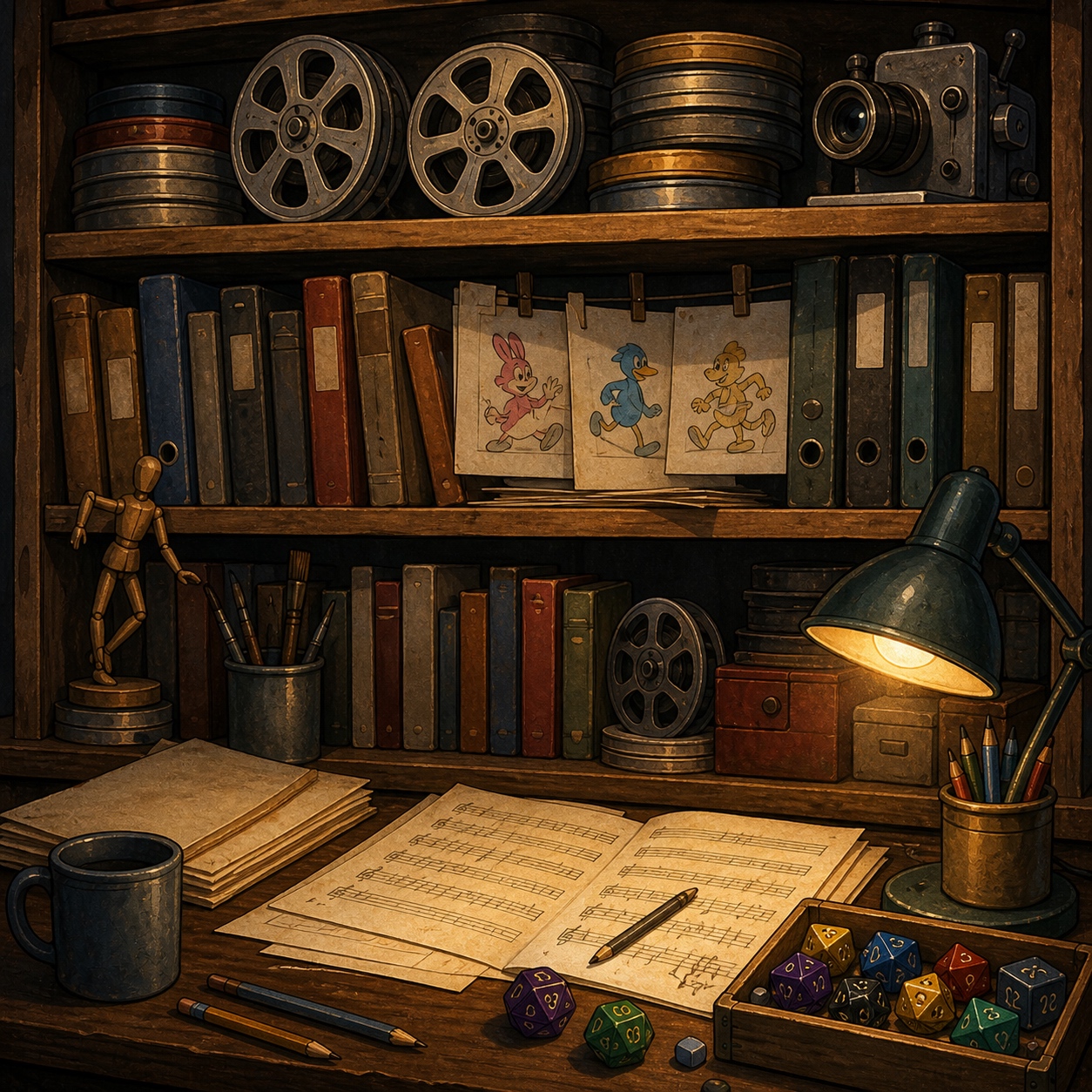
The library this book was built from. None of the works below are required reading, the book stands alone, but any of them will repay time spent, and several of them were open on the desk while this was written.
Film & Television
- Tex Avery’s MGM shorts — the single clearest reference for this book’s tone. Red Hot Riding Hood, King-Size Canary, Northwest Hounded Police. Timing, verbal-visual interplay, the knowing look to camera.
- Chuck Jones’ Warner Bros. shorts — especially Duck Amuck, What’s Opera, Doc?, Rabbit of Seville, and the entire Road Runner / Wile E. Coyote canon. If you read one Jones short: Duck Amuck is the whole Fourth Wall chapter in six minutes.
- The Fleischer brothers — Betty Boop, Popeye the Sailor, the early Superman cartoons. Pre-Code weirdness; the visual grammar of “rubberhose” animation that predates Disney.
- Friz Freleng — musical timing. Rhapsody Rabbit, Three Little Bops, the Sylvester/Tweety shorts.
- Hanna-Barbera’s MGM-era Tom and Jerry — not the 1970s TV rebrand. The MGM shorts are the single best reference for relentless physical gag escalation.
- Animaniacs (1993–98) — the studio-as-setting premise, the meta-jokes, the cartoon commentary on cartooning itself. Closest modern cousin to this book.
- Who Framed Roger Rabbit (1988) — still the definitive “toons as people” film. Watch it for the toon-town scenes and for the way Eddie Valiant learns the rules of cartoon logic.
- Looney Tunes: Back in Action (2003) — flawed film, invaluable backstage scenes.
- The Amazing World of Gumball — for cartoon-universe world-building and tonal range.
Books
- Chuck Jones, Chuck Amuck — the memoir. Closest thing to a GM guide that exists. Read before running your first Season.
- Michael Barrier, Hollywood Cartoons: American Animation in Its Golden Age — the definitive studio-history reference. Where the Warped Bros. / Mice House / ENDS taxonomy came from.
- Leonard Maltin, Of Mice and Magic — companion to the above, more accessible.
- Scott McCloud, Understanding Comics — the theory chapter on closure, the gutter, and panel-to-panel transition reads directly onto cartoon scene pacing.
- Neil Gaiman, Sandman — particularly the issues dealing with characters trapped in their defining roles. The Shtick Paradox in prose form.
- Grant Morrison, Flex Mentallo — meta-textual superhero work; directly applicable to Fourth Wall play.
Games
- Toon (Steve Jackson Games, 1984) — the ancestor. Simpler, older, beloved. Every cartoon RPG since owes it something.
- Cartoon Action Hour (Spectrum Games) — 80s Saturday-morning tone in RPG form.
- Fiasco — for one-shot structure and how characters’ Wants can collide productively.
- Monsterhearts — for why locked identities produce drama, and how moves can encode them.
- Powered by the Apocalypse family — for stance-based GM play, which informs the director-not-referee framing in Chapter Eleven.
Music
- Carl Stalling — Looney Tunes and Merrie Melodies. Your library starts here.
- Raymond Scott — Powerhouse, The Toy Trumpet, Dinner Music for a Pack of Hungry Cannibals. The sound of American cartoons whether or not the listener knows it.
- John Zorn, The Carl Stalling Project — Stalling’s scores isolated from their cartoons.
- Spike Jones & His City Slickers — the big-band novelty songs that are pure cartoon.
- Bernard Herrmann’s North by Northwest — for when the cartoon wants to be a thriller.
- Danny Elfman’s Pee-wee’s Big Adventure — modern cartoon orchestra.
Player Quickstarts
Use these pages when the table wants to begin quickly, when a new player joins mid-Season, or when someone understands the premise but does not want to read the whole book before Session 1.
The Three Rules Players Actually Need
- Commit to your Shtick. If your action expresses your Shtick, you usually get +1 Boon die . If it contradicts your Shtick, the universe pushes back.
- Spend Gag Tokens. They are there to make scenes bigger, weirder, and more recoverable.
- Take the hit when it is funny. Elasticity comes back. The reputation of dodging a perfect anvil does not.
One-Page Player Start
| Step | Do This | Where |
|---|---|---|
| 1 | Pick a Look. It is cosmetic, so choose the funniest silhouette. | Chapter Three |
| 2 | Pick a Type. This sets characteristics and one free signature ability. | Chapter Three |
| 3 | Pick a Shtick. This is your locked one-sentence cartoon identity. | Chapter Three |
| 4 | Pick three starting Bits: two from your Shtick list, one that fits. | Chapter Five |
| 5 | Write a Want that cannot be solved in one episode. | Chapter Three |
| 6 | Set one Bond with each other PC, from -1 to +1. | Chapter Three |
| 7 | Spend 80 XP on characteristics, skills, and talents. | Chapter Three / Core Rules |
| 8 | Take one free Tier 1 universal talent. | Core Rules |
| 9 | Choose gear item by item or take a starting gear package. | Chapter Six |
| 10 | Add name, voice, color, catchphrase, and one secret. | Chapter Three |
Quickstart: The Standard Ensemble
If your table wants to start fast, build the ensemble straight from the Legal Starting Ensemble Templates table on the next page: the first five rows cover the main roles of a classic cartoon show, and either Wildcard row fills a sixth seat. Every player picks a different concept and the party runs.
Legal Starting Ensemble Templates
| Concept | Type | Shtick | Starter Bits | Good First Want |
|---|---|---|---|---|
| The Trophy-Chasing Goat | Bruiser | Loose Cannon | Pocket Dynamite, Crash the Scene, Collateral Damage | “Prove I am the best every episode.” |
| The Clipboard Coyote | Brain | Self-Sabotaging Genius | Elaborate Trap, Gadget That Only Works Once, Last-Second Monologue | “Catch the rival with a plan that finally works.” |
| The Alley Mouse | Zip | Scheming Little One | The Dawdle, Improvised Booby Trap, Fast Talk | “Make the big studio fear small talent.” |
| The Velvet Fox | Charmer | Spotlight Thief | Steal the Scene, Ham It Up, To the Camera | “Top billing, permanently.” |
| The Tired Stage Manager | Pro | Unflappable Straight Man | Deadpan Reaction, The Explanation, Quiet Disapproval | “Get through one clean production day.” |
| The Well-Meaning Disaster | Wildcard | Lovable Dope | Sincere Question, Accidental Genius, Big Hug | “Make everyone on the lot friends.” |
| The Walking Liability | Wildcard | Chaos Magnet | Anvil Magnet, Wait What Just Happened, Disaster Survival | “Find out why the anvils know my name.” |
Pregenerated Characters
The seven pregens below are legal starting PCs. Each uses the Chapter Three starting package: Type, Shtick, three filled Bit slots, 80 XP spent on skills, one free Tier 1 universal talent, one free Type signature ability, and one 500 PC starting gear package. They are written to work as a table ensemble or as single drop-in replacements when a new player joins mid-Season.
All listed Resistance values are before worn armor or shields. If a pregen uses armor from a starting gear package, add that item’s Resistance Bonus and Defense while it is equipped.
Gilda “Grit” Goat, Trophy-Chasing Menace
- Look: short boxing goat with taped horns, a medal rack, and one cracked trophy she refuses to explain.
- Type / Shtick: Bruiser / Loose Cannon.
- Identity: “I am explosive, I am beloved, and I am going to win this scene.”
- Want: Prove she is the best every episode.
- Voice / Catchphrase / Color: gravelly gym-coach bark; “Put me in the cannon.”; brass yellow.
- Secret: Grit is terrified of being recast as a background farm animal.
- Type Ability: Built to Bounce - +2 starting Elasticity; when she spends a Gag Token to return from Wiped Out, she returns at half maximum Elasticity instead of 1.
- Bits: Pocket Dynamite, Crash the Scene, Collateral Damage.
- Free Tier 1 Universal Talent: Specialist: Brawl when making over-the-top takedowns.
- Starting Gear: Slapstick Tank package.
- Ranked Skills (80 XP): Brawl 3, Athletics 2, Ranged 2, Intimidation 2, Pratfall 1.
- Opening Bonds: +1 with the Tired Stage Manager, who knows how to reset the set after Grit hits it; -1 with the Clipboard Coyote, whose plans keep putting Grit in the wrong cannon.
- Play Her When: the table needs a direct problem-solver who turns every locked door into a repair bill.
Cassandra Clip, The Clipboard Coyote
- Look: narrow coyote in cracked goggles, pencil behind both ears, clipboard chained to one wrist.
- Type / Shtick: Brain / Self-Sabotaging Genius.
- Identity: “I have a brilliant plan, and the final step is always me explaining it too long.”
- Want: Catch the rival with a plan that finally works.
- Voice / Catchphrase / Color: clipped, technical, too fast when excited; “Observe the elegance of phase seven.”; blueprint blue.
- Secret: Cassandra’s best trap design was stolen by Warped Bros., and she still sends invoices.
- Type Ability: Overthinker - once per scene, ask the GM one truthful clarifying question about the current scene.
- Bits: Elaborate Trap, Gadget That Only Works Once, Last-Second Monologue.
- Free Tier 1 Universal Talent: Specialist: Gag-Craft when setting traps with visible moving parts.
- Starting Gear: Backlot Trickster package.
- Ranked Skills (80 XP): Gag-Craft 3, Craft 2, Science 2, Deception 2, Perception 1.
- Opening Bonds: +1 with the Alley Mouse, who appreciates a well-rigged hallway; -1 with the Trophy-Chasing Goat, who keeps triggering traps early.
- Play Her When: you want to build scene engines, ask good GM questions, and enjoy being hoisted by your own blueprint.
Mina Skitter, Alley Mouse
- Look: tiny street mouse in a patched hoodie, oversized sneakers, and a grin that arrives before she does.
- Type / Shtick: Zip / Scheming Little One.
- Identity: “I am small, I am clever, and you already missed me.”
- Want: Make the big studio fear small talent.
- Voice / Catchphrase / Color: quick, bright, and always half a room away; “Too slow, big shot.”; bottle green.
- Secret: Mina has a hidden clubhouse in the ventilation system above Stage 4.
- Type Ability: Zoom - once per round as a Quick Action, move to any visible location in line of sight if it could plausibly be run around.
- Bits: The Dawdle, Improvised Booby Trap, Fast Talk.
- Free Tier 1 Universal Talent: Specialist: Stealth while escaping through scenery or crowd clutter.
- Starting Gear: Chase Runner package.
- Ranked Skills (80 XP): Stealth 3, Gag-Craft 2, Coordination 2, Subterfuge 2, Deception 1.
- Opening Bonds: +1 with the Clipboard Coyote, because the best traps need someone fast enough to arm them; -1 with the Velvet Fox, who keeps turning chase exits into entrances.
- Play Her When: you want to start chases, exploit size, and make bigger characters waste their whole turn being offended.
Velvet Vulpina, The Velvet Fox
- Look: elegant fox in a sequined jacket, opera gloves, and a permanent three-quarter camera angle.
- Type / Shtick: Charmer / Spotlight Thief.
- Identity: “If a camera is on, I am in front of it.”
- Want: Top billing, permanently.
- Voice / Catchphrase / Color: velvet stage whisper with sudden showtime volume; “Darling, find my light.”; crimson.
- Secret: Velvet once played a sincere supporting role and is terrified people liked it better.
- Type Ability: Audience Favorite - begin every session with one extra Gag Token; gain 1 automatic Success on social checks against crowds of three or more.
- Bits: Steal the Scene, Ham It Up, To the Camera.
- Free Tier 1 Universal Talent: Specialist: Performance when playing to a visible audience.
- Starting Gear: Stage Star package.
- Ranked Skills (80 XP): Performance 3, Charm 2, Fourth-Wall 2, Deception 2, Negotiation 1.
- Opening Bonds: +1 with the Well-Meaning Disaster, who gives Velvet sincere applause; -1 with the Tired Stage Manager, who keeps asking Velvet to hit the mark instead of improving the scene.
- Play Her When: you want to manage Audience Reaction, steal credits, and turn another character’s disaster into your curtain call.
Marla Mainspring, The Tired Stage Manager
- Look: old gray dog in a headset, tool belt, sensible shoes, and an expression that has seen every gag twice.
- Type / Shtick: Pro / Unflappable Straight Man.
- Identity: “I am the only reasonable toon in this studio and it is killing me.”
- Want: Get through one clean production day.
- Voice / Catchphrase / Color: dry, calm, almost asleep until the set catches fire; “We rehearsed this.”; slate gray.
- Secret: Marla keeps a completed resignation letter in every jacket.
- Type Ability: Been Here Before - once per scene after rolling a check, re-roll the entire pool and keep the second result.
- Bits: Deadpan Reaction, The Explanation, Quiet Disapproval.
- Free Tier 1 Universal Talent: Specialist: Leadership when restoring order on set.
- Starting Gear: Lot Professional package.
- Ranked Skills (80 XP): Readiness 3, Leadership 2, Perception 2, Resilience 2, Lore 1.
- Opening Bonds: +1 with the Trophy-Chasing Goat, who at least commits to a plan once it starts; -1 with the Velvet Fox, who treats every schedule as a suggestion.
- Play Her When: you want to anchor chaos, keep the table pointed at the objective, and get the laugh by refusing to react.
Bixie Button, Well-Meaning Disaster
- Look: round plush toy toon with mismatched button eyes, a messenger bag full of snacks, and hands that always wave too close to breakables.
- Type / Shtick: Wildcard / Lovable Dope.
- Wildcard Characteristic: +1 Charisma.
- Identity: “I am happy, I am wrong about most things, and I love you.”
- Want: Make everyone on the lot friends.
- Voice / Catchphrase / Color: warm, soft, and absolutely certain; “I helped.”; candy pink.
- Secret: Bixie accidentally knows the Network executive’s real first name.
- Type Ability: Rolling with It - once per scene, use a different characteristic for a check with brief fictional justification and gain +1 Boon die .
- Bits: Sincere Question, Accidental Genius, Big Hug.
- Free Tier 1 Universal Talent: Specialist: Charm when offering sincere help.
- Starting Gear: Stage Star package.
- Wildcard Profession Skills: Charm, Resilience, Perception.
- Ranked Skills (80 XP): Charm 3, Pratfall 2, Resilience 2, Perception 2, Fourth-Wall 1.
- Opening Bonds: +1 with the Velvet Fox, because Velvet always looks lonely after applause; -1 with the Walking Liability, because Bixie keeps trying to stand under the same anvil to keep them company.
- Play Them When: you want to be the emotional center, fail forward, and accidentally solve problems by misunderstanding them.
Wally Drop, Walking Liability
- Look: long-necked stagehand toon with a dented hard hat, permanent dust cloud, and a small painted target he insists is decorative.
- Type / Shtick: Wildcard / Chaos Magnet.
- Wildcard Characteristic: +1 Willpower.
- Identity: “Disasters find me, I survive them, and I do not learn.”
- Want: Find out why the anvils know his name.
- Voice / Catchphrase / Color: dazed, gentle, always a sentence behind; “Was that scheduled?”; safety orange.
- Secret: Wally’s dressing room ceiling has never been repaired because the studio considers it a controlled test site.
- Type Ability: Rolling with It - once per scene, use a different characteristic for a check with brief fictional justification and gain +1 Boon die .
- Bits: Anvil Magnet, Wait What Just Happened, Disaster Survival.
- Free Tier 1 Universal Talent: Specialist: Pratfall when surviving falling objects or collapsing scenery.
- Starting Gear: Slapstick Tank package.
- Wildcard Profession Skills: Resilience, Perception, Survival.
- Ranked Skills (80 XP): Pratfall 3, Resilience 2, Perception 2, Survival 2, Fourth-Wall 1.
- Opening Bonds: +1 with the Tired Stage Manager, who has the accident reports ready before he lands; -1 with the Clipboard Coyote, whose traps keep mistaking Wally for “nearest available target.”
- Play Him When: you want to absorb disasters, hand the GM excellent escalation hooks, and make survival itself the running gag.
Player Advancement Quickstart
| Goal | Spend XP On | Why |
|---|---|---|
| Land your core gag more often | Raise the skill tied to your favorite Bit | Your best scene gets more reliable without changing who you are |
| Broaden your toolkit | Buy a new Bit slot, then learn a Bit | Shtick stays locked, repertoire grows |
| Become easier to write scenes around | Improve Bonds and pursue your Want | The GM gets stronger hooks |
| Survive louder slapstick | Raise Pratfall, Resilience, or buy durability talents | You can take bigger hits and stay active |
| Own the camera | Raise Performance, Fourth-Wall, Charm, or related talents | Audience Reaction and Billing become easier to chase |
| Get weirder between Seasons | Swap one Bit or negotiate a rare Shtick change at Hiatus | Big identity moves belong between Seasons |
In-Shtick / Against-Shtick Ruling Table
| If the Player Says... | Likely Ruling | Why |
|---|---|---|
| “I explain the whole plan while the trap arms itself around me.” | In-Shtick for a Self-Sabotaging Genius | The action invites the flaw that ruins the genius |
| “I quietly choose the simple solution and give someone else credit.” | Against-Shtick for a Self-Sabotaging Genius | It avoids ego, complexity, and self-defeat |
| “I stare into camera while everyone else screams.” | In-Shtick for an Unflappable Straight Man | The joke is restraint under pressure |
| “I scream, grab dynamite, and join the mob.” | Against-Shtick for an Unflappable Straight Man | It abandons the anchor role |
| “I walk under the piano because I am reading the wrong sign.” | In-Shtick for a Chaos Magnet | Disaster finds them because they are in exactly the wrong place |
| “I inspect the ceiling rig and avoid the piano.” | Against-Shtick for a Chaos Magnet | The toon is preventing the disaster instead of attracting it |
| “I turn the chase into my solo number.” | In-Shtick for a Spotlight Thief | The action redirects attention to the performer |
| “I step aside so another PC can have the applause.” | Against-Shtick for a Spotlight Thief | It rejects the camera |
How to Be Funny Without Trying Too Hard
You do not need to be a comedian to play Ink & Mayhem. The system rewards clear character behavior more than clever lines. Comedy at the table usually comes from commitment, contrast, repetition, and timing.
| Instead Of... | Do This |
|---|---|
| Hunting for a perfect joke | State what your toon sincerely wants right now |
| Quoting a meme or reference | Add one specific physical detail to the scene |
| Making fun of another player | Make your own toon wrong, doomed, vain, confused, or overcommitted |
| Escalating forever | Escalate once, then let someone else answer it |
| Explaining why the bit is funny | Play the consequence straight |
| Trying to win every exchange | Choose the funnier failure when Elasticity or Strain can absorb it |
| Breaking character to be clever | Let the Shtick be the joke engine |
| Punching down | Aim the gag at props, pride, status, timing, or your own toon |
The best move is often a simple one: repeat your Shtick under new pressure. The Straight Man sighs at a bigger disaster. The Genius explains a worse plan. The Spotlight Thief finds a smaller camera and treats it like a premiere. The Lovable Dope misunderstands one more crucial word.
GM Quick Guides
These are table-facing tools for running the next Episode without rereading Chapters Nine through Eleven.
Session Prep Checklist
Do this before the players sit down.
| Prep Item | Done |
|---|---|
| Write the Episode question: “Can the toons...?” | [ ] |
| Pick the cold open image. | [ ] |
| Pick one PC Want to pressure. | [ ] |
| Pick one Bond to test or highlight. | [ ] |
| Choose the main location. | [ ] |
| Choose one adversary or faction pressure. | [ ] |
| Choose one environmental threat or prop complication. | [ ] |
| Decide whether Audience Reaction matters this Episode. | [ ] |
| Check each PC’s current Billing. | [ ] |
| Check whether anyone is in Audience Slump, Tab Crisis, Standards Watch, Bond Collapse, or Want Stagnation. | [ ] |
| Prepare one consequence that is not Elasticity damage. | [ ] |
| Prepare the sting: the last image after the credits. | [ ] |
Ten-Minute Episode Skeleton
| Beat | Prep One Sentence |
|---|---|
| Cold Open | What absurd image starts the Episode? |
| Act One | What job, rumor, contract note, or problem forces the PCs into motion? |
| Act Two | What arrives early, breaks, complains, gets flagged, or makes the scene worse? |
| Act Three | What chase, confrontation, showpiece gag, or public performance pays it off? |
| Sting | What final image tells the table the cartoon is over? |
Difficulty Quick Guide
| If Success Would... | Difficulty |
|---|---|
| Add color, a small joke, or a harmless detail | No roll |
| Create a small convenience | Easy |
| Create a real advantage | Average |
| Swing the scene | Hard |
| Swing the Episode | Severe |
| Swing the Season | Extreme, or make it an arc |
If the ask contradicts the PC’s Shtick, apply the Against-Shtick penalty. If the ask pays off setup, fits the Shtick, or makes another PC look good, add Boon dice before raising difficulty.
Non-Death Consequence Menu
| Consequence | Use When |
|---|---|
| Audience Reaction drops | The gag is visible and the Audience does not buy it |
| Audience Favor is not earned | The PC succeeds but does not commit to Shtick, risk, or performance |
| Tab increases | Props break, property damage lands, or a requisition gets abused |
| Standards Board flag | A gag crosses the in-universe line or draws censor attention |
| Bond shifts | A PC chooses a Want over a relationship, or vice versa |
| Want is complicated | The PC gets closer to the Want, but the chase becomes harder |
| Rival claims credit | The action succeeds, but someone else controls the public story |
| Contract review | Audience Slump, Tab Crisis, or repeated Standards flags have accumulated |
| Forced hiatus / real job | A Season-level consequence after a failed recovery arc |
Adversary Quick Scaling
| Table / Scene | Use |
|---|---|
| 3 PCs or first session | 1 Minion group or 1 Elite |
| 4 PCs | Printed values |
| 5-6 PCs | Add a Minion group, larger group size, or one extra Bit use |
| Mid-Season experienced PCs | Add +1 to the adversary’s core skill or one fitting Bit |
| Episode climax | Add an environmental threat or countdown |
| Season finale | Add contract, Bond, Want, or Billing stakes instead of more damage |
Season Worksheet
| Question | Answer |
|---|---|
| Season length | |
| Season title | |
| Top Billed / likely arc anchor | |
| PC who needs spotlight | |
| Bond to test | |
| Want to pressure early | |
| Active rival or faction | |
| Nemesis in the arc | |
| Recurring prop, location, or gag | |
| Off-set problem getting worse | |
| Possible permanent finale change |
Example Scene of Play
This example shows the GM using difficulty-by-impact, Shtick rulings, non-death consequences, and adversary pressure in one scene.
Setup: The PCs are filming a short on Stage 7. The Episode question is: Can the toons deliver a sponsor-friendly safety film before Warped Bros. steals the reel? The Audience Reaction tracker is active because the short is being screened live for executives.
Cast in scene:
- Pip Sprocket, Zip / Scheming Little One.
- Brock Ramstrong, Bruiser / Loose Cannon.
- Monty Gildersnout, Charmer / Spotlight Thief.
- Pie Squad Saboteurs, Minion group.
- J. Lemington Crust, watching from the edge of the set with a red stamp.
Opening Beat
The GM frames the shot: the safety-film set is a pristine kitchen with a sign reading DO NOT RUN WITH SCISSORS. The Pie Squad has replaced the safety scissors with rocket scissors. The live Audience is already murmuring.
Pip’s player says, “I want to rig the kitchen drawers so every drawer opens into a different drawer.”
The GM asks two questions silently: how big is the ask, and how much would success change? This creates a real advantage but does not end the scene, so the GM calls for an Average Intellect check using Gag-Craft. Pip is a Scheming Little One and is using cheap set materials, so this is In-Shtick and gains +1 Boon die .
Pip succeeds with 2 Boons. The drawers become a looping maze. The GM lets Pip spend the Boons to add 1 Bane die to the Pie Squad’s next movement check through the kitchen.
Escalation Beat
Brock sees the rocket scissors streaking toward the sponsor logo and says, “I tackle the scissors through the refrigerator.”
That is absolutely In-Shtick for a Loose Cannon. The action is big, but it solves only the immediate hazard, not the whole scene, so the GM sets Hard Might using Athletics and adds the In-Shtick Boon die . Brock succeeds but generates a Calamity.
The scissors miss the sponsor logo. Brock goes through the refrigerator, through the wall, and through a catering table. The GM applies the success, then resolves the Calamity as a Tab increase and a complication: Old Murgatroyd appears in the hole with a receipt book. The debt is now visible on-screen.
Spotlight Beat
Monty steps into the wreckage and says, “Clearly, this was a demonstration of what not to do.”
Monty is a Spotlight Thief reframing a disaster as performance, so this is In-Shtick. Because success could flip the live audience from concern to applause, the GM sets Hard Charisma using Performance. Monty succeeds with enough Boons to increase Audience Reaction by 1. The table agrees the moment is visible and committed, so Monty earns 1 Audience Favor tick.
Crust raises the red stamp. The GM spends 1 Chaos Point and triggers Flagged by the Standards Board because the safety film has become dangerously exciting. Monty can accept the flag, spend a Gag Token to soften it, or invite another PC to help.
Combat Beat
The Pie Squad recovers and presses the attack. The GM resolves a single combat round in full so the table sees the dice flow.
The Pie Squad attacks Brock. The squad of four uses Pie Barrage, a single coordinated Ranged attack against everyone Engaged. Brock is the closest target. The GM builds the Pie Squad’s pool from its stat block (Chapter Nine): Agility 2 / Ranged 2. Per pool construction, the higher rating sets the number of dice and the lower sets how many upgrade, so both Ability dice upgrade to Mastery: 2 Mastery dice , against 2 Trial dice of difficulty. No environmental modifiers, no In-Shtick (Minions do not get Shtick bonuses), no help. The GM rolls and produces 2 Successes and 1 Boon, net.
Resolving damage on Brock. The Pie has a flat damage of 1, plus the 1 Boon spent for +1 damage = 2 raw damage. Brock’s Resistance is half Might (3) rounded up + no armor = 2. 2 damage − 2 Resistance = 0 Elasticity lost. The pie still lands, narratively (Brock is now Drenched from the Cartoony 2 quality and the slapstick splatter), but his Elasticity track did not move. The GM notes Drenched on Brock’s sheet (1 Bane die to Coordination checks for the rest of the scene).
Brock answers with the Frying Pan. Brock’s player declares a Brawl attack on the lead Pie Squad squaddie, swung from inside the gelatin mold. The pool is built per the Core Rules and Chapter Eight:
- Characteristic + Skill: Might 3, Brawl 2 → 1 Ability die + 2 Mastery dice , built by the same pool rule as the Pie Squad's attack above.
- Difficulty: Average melee at Engaged → 2 Trial dice .
- In-Shtick: Brock is a Loose Cannon swinging a kitchen weapon mid-wreckage → +1 Boon die .
- Drenched: Drenched adds 1 Bane die to Coordination checks only, so it leaves this Brawl pool alone.
Final pool: 1 Ability + 2 Mastery + 2 Trial + 1 Boon. Brock rolls 4 Successes, 2 Boons, no Calamity.
Resolving damage on the Pie Squad. Frying Pan damage is Might + 2 = 3 + 2 = 5 base damage. Brock spends 1 of his Boons for +1 damage → 6 damage. The Pie Squad Minion group has Resistance 3 and a Wound track of 5. 6 − 3 = 3 Elasticity lost. The Frying Pan also has Stun 2, so Brock spends his second Boon to apply Stun (next squaddie action upgrades a Trial die to Crisis ).
Wound track and Minion attrition. Per Core, a Minion group’s pooled Wounds = per-Minion Wounds × group size. The Pie Squad started at 4 squaddies × 5 = 20 group Wounds. After Brock’s hit they sit at 20 − 3 = 17 / 20. No squaddie drops yet; 2 more lost from the pool (5 total suffered) will eliminate one Minion from the group.
Crit threshold check. The Frying Pan has Crit 4. Per Chapter Eight, a Perfect Cartoon Moment triggers on Crit + 2 = 6 net Boons spent on a successful attack (a Breakthrough counts as 3 toward this total). Brock spent 2 Boons on damage and Stun; no Breakthrough was rolled. No PCM this round. Had Brock rolled a Mastery Breakthrough, he would have been at 3 + 2 = 5 of the 6 needed and could have dumped one more Boon to hit the threshold and launch the lead squaddie into the rafters, narrated as Wiped Out for that single squaddie.
Round ends. The Pie Squad is bruised, sticky, and one good swing from losing a member. Brock is dripping pie and grinning.
What This Beat Demonstrated
- Minion group pool construction and group Wounds (Chapter Nine; Core Rules)
- Resistance and Elasticity (Chapter Eight)
- Weapon qualities: Cartoony, Stun, Slapstick (Chapter Six)
- Cartoon Conditions on zero-damage hits (Chapter Eight)
Shared Resolution
Pip uses Fast Talk to argue that the film is safer now because nobody watching will ever touch scissors again. The GM rules this is a scene-swinging social save under censor scrutiny: Hard Charisma using Deception, plus 1 Bane die from Crust’s attention. Pip is still operating as a Scheming Little One, talking rings around a larger authority, so the check gains +1 Boon die .
Pip barely succeeds. Crust does not flag the Episode, but the sponsor demands a new disclaimer. The GM writes down a non-death consequence: Sponsor Disclaimer. Next Episode, one cold-open gag must include a sponsor-friendly safety message or the Executive will schedule a contract review.
The scene ends with the camera panning to the refrigerator hole, where Brock sits inside a giant gelatin mold, giving a thumbs-up beside a sign reading SAFE ENOUGH.
What This Scene Demonstrated
- Difficulty by impact (Chapter Eleven)
- In-Shtick and Against-Shtick rulings (Chapter Eight)
- Non-death consequences (Non-Death Consequence Menu above)
- Layered adversary pressure (Chapter Nine)
- Closing the scene on a concrete image (Chapter Ten)
Rules Summaries
These summaries are quick references. Full rules live in Chapters Three, Five, Six, Eight, Nine, Ten, and Eleven.
Session Start
| Step | Do |
|---|---|
| 1 | Reset Gag Tokens to one per player, plus any character-specific bonuses. |
| 2 | Reset GM Chaos to 1. |
| 3 | Note current Billing for each PC. |
| 4 | Check tab balances, Audience Slump, Standards flags, Bonds, Wants, and active Season pressure. |
| 5 | Frame the cold open. |
Check Flow
| Step | Do |
|---|---|
| 1 | Identify the ask and the scene impact. |
| 2 | Choose characteristic + skill. |
| 3 | Set difficulty by impact. |
| 4 | Apply In-Shtick Boon or Against-Shtick Trial upgrade. |
| 5 | Add Boon/Bane dice from help, props, setup, environment, and conditions. |
| 6 | Roll and cancel symbols per Core Rules. |
| 7 | Add automatic Successes after rolling and cancellation. |
| 8 | Spend Boons, Breakthroughs, and Gag Tokens as appropriate. |
| 9 | Resolve Calamities and consequences. |
Shtick
| Situation | Effect |
|---|---|
| Action clearly expresses Shtick | Add +1 Boon die |
| Action contradicts Shtick | Upgrade one Trial die to Crisis |
| Toon meaningfully plays Shtick during session | +2 XP |
| Toon avoids or ignores Shtick all session | +1 XP |
| Shtick change | Hiatus only, after a Want resolves and the table agrees |
Elasticity and Wiped Out
| Rule | Summary |
|---|---|
| Elasticity | 10 + Might, modified by talents, Type, and explicit rules |
| Resistance | half Might rounded up + armor Resistance Bonus + explicit bonuses |
| Scene end | Recover all Elasticity |
| Mid-scene recovery | Spend a Gag Token once per scene to recover 3 Elasticity |
| Wiped Out | At 0 Elasticity, removed from scene until next scene |
| Pop back early | Spend a Gag Token to return at top of next round at 1 Elasticity |
| Critical Injuries | Not used in Ink & Mayhem |
Gag Tokens and Chaos
| Currency | Use |
|---|---|
| Gag Token | Core Fortune uses, pop back early, recover Elasticity, fuel setting options |
| Chaos Point | Core Peril uses, complications, environmental threats, pressure escalation |
| Reset | Both reset at session start; generated tokens can exceed starting values during play |
Audience and Billing
| Track | Scale | Use |
|---|---|---|
| Audience Reaction | Scene | -5 to +5, used when a scene is visibly performed for the Audience |
| Audience Favor | Season | Earned by visible, committed, audience-worthy moments |
| Billing | Season | Top Billed, Featured, Supporting, In the Back; changes only at Season finale |
| Audience Slump | Multi-Episode | Three consecutive weak audience Episodes triggers a Cancellation Arc |
Episode Structure
| Beat | Time | Job |
|---|---|---|
| Cold Open | 0-20 min | Start with a vivid gag image |
| Act One | 40-50 min | Introduce the Episode question |
| Act Two | 40-60 min | Complicate, escalate, introduce rival pressure |
| Act Three | 30-40 min | Chase, confrontation, payoff |
| Sting | 2-5 min | End on one final image |