PDF Download the Ink & Mayhem Universe Guide 24.0 MB
Every game has two jobs: keep the players moving, and keep the world coherent. Ink & Mayhem adds a third, and it is the one most games do not require: keep the table funny without forcing the table to be funny. You are running a show on which jokes happen rather than a joke-generation service.
This chapter is GM-to-GM, from the writers’ trailer to the writers’ trailer. Some of it is tonal. Some of it is mechanical. Some of it is a list of rulings you can point at when the table needs a decision. None of it is universal, the best running advice is always what works at your table, but what follows has held up across enough playtests to be worth writing down.
Read the whole chapter once before your first Season. After that, reach for it when something is going sideways; there is almost always a note in here about the specific thing going sideways.
Running Ink & Mayhem
Your stance at the table is not judge, not referee, not architect. Your stance is director. A director’s job is to keep every shot alive, cut away from dead air, and make sure the actors know what show they are on. When the PCs commit to a bit, frame it so the bit lands; when they freeze, cut to the thing that will unfreeze them.
The concrete habit: after a PC action, before you adjudicate, frame the shot. What does the camera see? Where is the reaction? Whose face do we cut to? The rest of the advice in this chapter flows from that one habit.
Holding the Tone
Ink & Mayhem is a golden-age cartoon game. The reference library is Tex Avery, Chuck Jones, the Fleischer brothers, early Hanna-Barbera at their best, Friz Freleng; it is not Ren & Stimpy, not Rick and Morty, not Family Guy, not adult animation of any era. This is a book about characters who are silly, earnest, dangerous, and fundamentally kind, even the villains are kind, once the short is over.
What this means at the table:
- Earnestness is the default. Characters may be devious, greedy, lazy, or vain, but never cynical: everyone in this universe thinks the gag matters.
- Violence lands cartoon. When a PC hits another toon with an anvil, the camera cuts to the dust cloud, the accordion-shaped silhouette, the little stars orbiting the head. It does not cut to a red splatter. If the table starts describing violence in a realistic register, step in and reframe: what does that look like in a cartoon?
- Suffering is brief and funny. Pain is a setup for a reaction shot: an anvil drops, the toon flattens, the toon peels off the pavement and says something wry. No dwelling.
- Meanness is not Shtick. A PC whose entire Shtick is cruelty will grind the table down by Session Three. If a player’s Shtick is drifting there, talk to them between sessions and help them find the fun underneath the meanness. (Usually it is jealousy, or ambition, or loneliness, and those are playable in a way pure meanness never is.)
When the tone drifts, the recovery move is almost always cut to a reaction shot, an NPC raising an eyebrow, the audience leaning in, a stagehand mouthing what?
Saying Yes (and When to Say No)
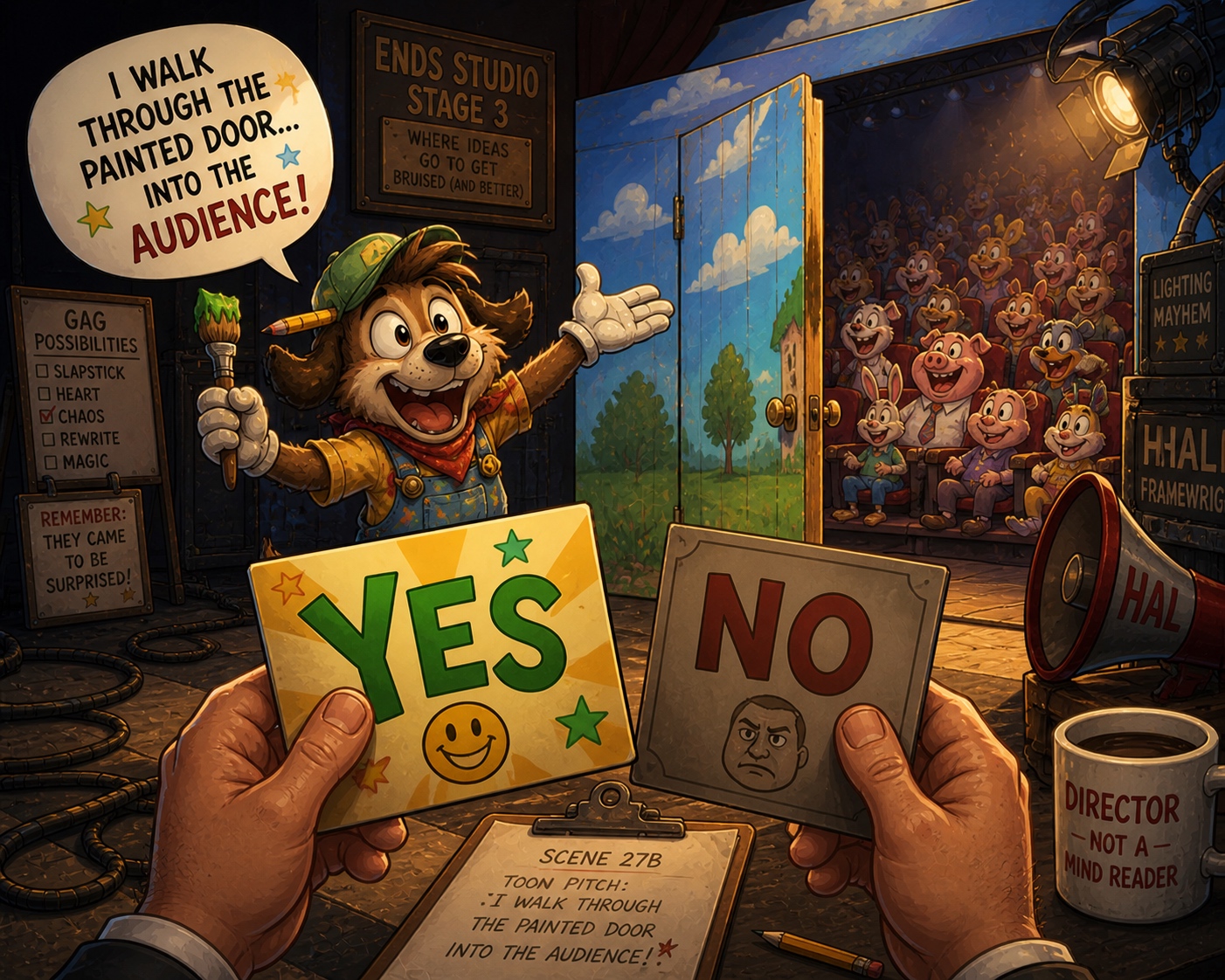
Ink & Mayhem is a say-yes game. When a player proposes something, your first instinct should be to find the version of yes that keeps the bit alive. This does not mean every proposal succeeds, dice still resolve, failure is still possible, consequences still land, but the permission to attempt should almost always be granted.
What Saying Yes Looks Like
- “Can I pull a mallet out of nowhere?” Yes. What does it look like?
- “Can I run off the cliff and not fall until I look down?” Yes. When does your character look down?
- “Can I paint a tunnel on a wall?” Yes. Who is chasing you?
- “Can I just walk through the fourth wall?” Roll Fourth-Wall (Chapter Four). Then yes.
- “Can I be in two places at once for this gag?” Yes, for this gag. Next scene, you are in one place.
The GM-side language for all of these is: roll for it (if there’s a check worth making), or sure, and (if there isn’t). Resist the urge to add friction for friction’s sake. The audience is watching; make sure there is something for them to watch.
When to Say No
The hard noes are rare, and most of them are tonal:
- When a bit breaks one of the Eight Conceits (Chapter Two). These are the premises the whole book rests on. A player wants their toon to permanently die in a serious scene: no. The Conceits win.
- When one player is using a bit to bully another. Even inside the fiction, pie fights should be mutual. If a bit is weaponized against a specific player rather than their character, pause the scene and check in at the table level.
- When a “joke” targets a real-world group, real person, or real tragedy. This universe is already absurd; it does not need to reach outside itself for material, and reaching outside is almost always the shape of an unfunny scene. The punching bag in this book is the Studio. The system. The Executive. The Censor. Never a real group of people.
- When a player’s proposal would permanently remove another player’s agency: rewriting their Shtick, breaking a Bond without consent, forcibly retiring their PC. These are Season-level commitments, and Season-level commitments live in between-session conversations (the biggest of them, like Shtick changes, at Hiatus, between Seasons), never in-scene.
Treat every no in Ink & Mayhem as a redirect. Always give the player something to do instead. “Not that, but try this” is the shape of the no that keeps the table moving.
Difficulty in a Cartoon Universe
Do not set difficulty by asking whether the action is realistic. Set difficulty by asking two questions:
- How big is the ask inside this scene?
- How much would success change if it lands?
A toon painting a door on a wall is not automatically hard. If it gets them into the pantry during a quiet scene, it may not need a roll. If it bypasses the entire Act Three chase, it is a serious ask and deserves a serious pool.
| Ask / Event Scale | Scene Impact | Suggested Difficulty |
|---|---|---|
| Color, style, or harmless bit | Changes how the scene looks, not what it means | No roll, or Easy if timing matters |
| Useful convenience | Saves time, gets a prop, avoids small embarrassment | Easy |
| Real advantage | Opens a route, creates cover, wins a minor exchange, sets up another PC | Average |
| Scene swing | Ends a chase beat, traps an Elite, flips Audience Reaction, bypasses a major obstacle | Hard |
| Episode swing | Resolves the episode premise, defeats a Nemesis for the session, rewrites the set’s premise | Severe |
| Season swing | Changes Billing pressure, retires a rival, resolves a Want, alters a faction relationship | Extreme or no single roll; require a scene or arc |
What Makes a Check Harder
Increase difficulty, add Bane dice , or upgrade Trial dice when the action has one of these pressures:
| Pressure | Mechanical Move |
|---|---|
| It contradicts the PC’s Shtick | Apply Against-Shtick: upgrade one Trial die to Crisis |
| It skips a whole scene the table wanted to play | Raise difficulty one step or require a cost |
| It affects another PC’s agency | Require consent or move it to a Season-level conversation |
| It breaks a locked premise of the episode | Raise difficulty one step and name the consequence |
| It happens under Standards Board scrutiny | Add 1 Bane die or threaten a flag |
| It risks the Audience turning | Put Audience Reaction on the line |
| It uses rare or unpaid props | Add tab cost or require a Prop Department beat |
What Makes a Check Easier
Lower difficulty or add Boon dice when the action:
- Expresses the PC’s Shtick clearly.
- Pays off an earlier setup.
- Uses a fitting Bit, Bond, Want, prop, or location.
- Makes another PC look good.
- Chooses the funnier failure over the safer success.
- Keeps the episode moving toward a stronger button.
Difficulty Ruling Shortcut
If the action is funny but low-impact, say yes and skip the roll. Anything bigger takes its difficulty from the scale table above.
The Shtick Paradox from the GM Chair
Chapter Two set the problem (cartoons resist change, RPGs demand progression), and Chapter Five’s Bit economy plus Chapter Eight’s Session / Season / Studio Loop are the mechanical solution. The GMing stance that makes the solution work is this: the Shtick is locked; everything around it is not.
A PC’s one-sentence Shtick should feel essentially the same in Session 1 and Session 50; Bugs is Bugs. When a player asks “can my character grow?” the answer is yes, in three places: their Bit repertoire (their craft), their Bonds (their context), and their Want (their horizon). A well-run Season leaves the Shtick unchanged on the page while the Bits sharpen, the Bonds deepen, and the Want shifts.
When a player proposes a Shtick change, take it seriously, it is a bigger move than it sounds; like any Season-level commitment (see Saying Yes, above), it waits for Hiatus. The right framing is: a character reaches the end of a Want that was fundamentally incompatible with their Shtick, and the resolution of that Want reveals a new identity. Those moments should be rare, earned, and celebrated.
Handling the Fourth Wall
The Fourth Wall subsystem (Chapter Eight) is the most interesting mechanic in the book and the easiest to break. Some notes from running it:
- Break universe-level, not player-level. A PC who addresses the audience is addressing the audience of the cartoon, a fictional entity inside the world, not the players, the GM, or the real world in 2026.
- Breaks are punctuation, not paragraphs. One knowing look to camera per scene. One raised eyebrow per bit. A monologue to the audience should feel rare and earned.
- Favor follows commitment. The tick goes to the player who sincerely delivered the moment, not to the sharpest meta-joke (see Running Audience Favor, below).
- The audience can hate you. A Fourth-Wall break that bombs, the wink that does not land, should reduce Audience Reaction, and the GM should name this at the table: “the audience doesn’t buy it.”
- The Roof is holy. Chapter Ten notes that Fourth-Wall checks on the Roof are one step easier. Protect this. It is the one location in the book where the Wall gets thin, and it should feel like a privilege to climb up there.
Running Audience Favor & Billing
Audience Favor and Billing (Chapter Ten) are the setting’s two backbone currencies at the Season scale; Gag Tokens, Chaos, and Audience Reaction handle the scene scale.
The tracking job is smaller than it sounds. For Favor, keep one column on your session notes. Every time a PC increases Audience Reaction or otherwise does something that the audience (fictional, in-universe) would notice and reward, landing a big bit, committing to a bond, breaking the Wall with conviction, sacrificing a mechanical advantage for a gag, put a tick in their column. At the end of the Season, count ticks. The highest goes up in Billing; the lowest goes down.
The table can suggest Favor. If a player says “that should earn Audience Favor” about another player’s moment, respect the suggestion. The table will usually be right. If you overrule, explain why briefly and move on.
Billing, once set, is hands-off until the Season finale: no mid-Season shifts, no threatening it as a consequence, no bargaining with it. It sits on the sheet and tells you who the camera favors this Season. When you are planning an episode, look at the Billing column the same way a showrunner looks at a call sheet, who is up this week, who is carrying the B-plot, whose Bond needs a scene.
Common Pitfalls
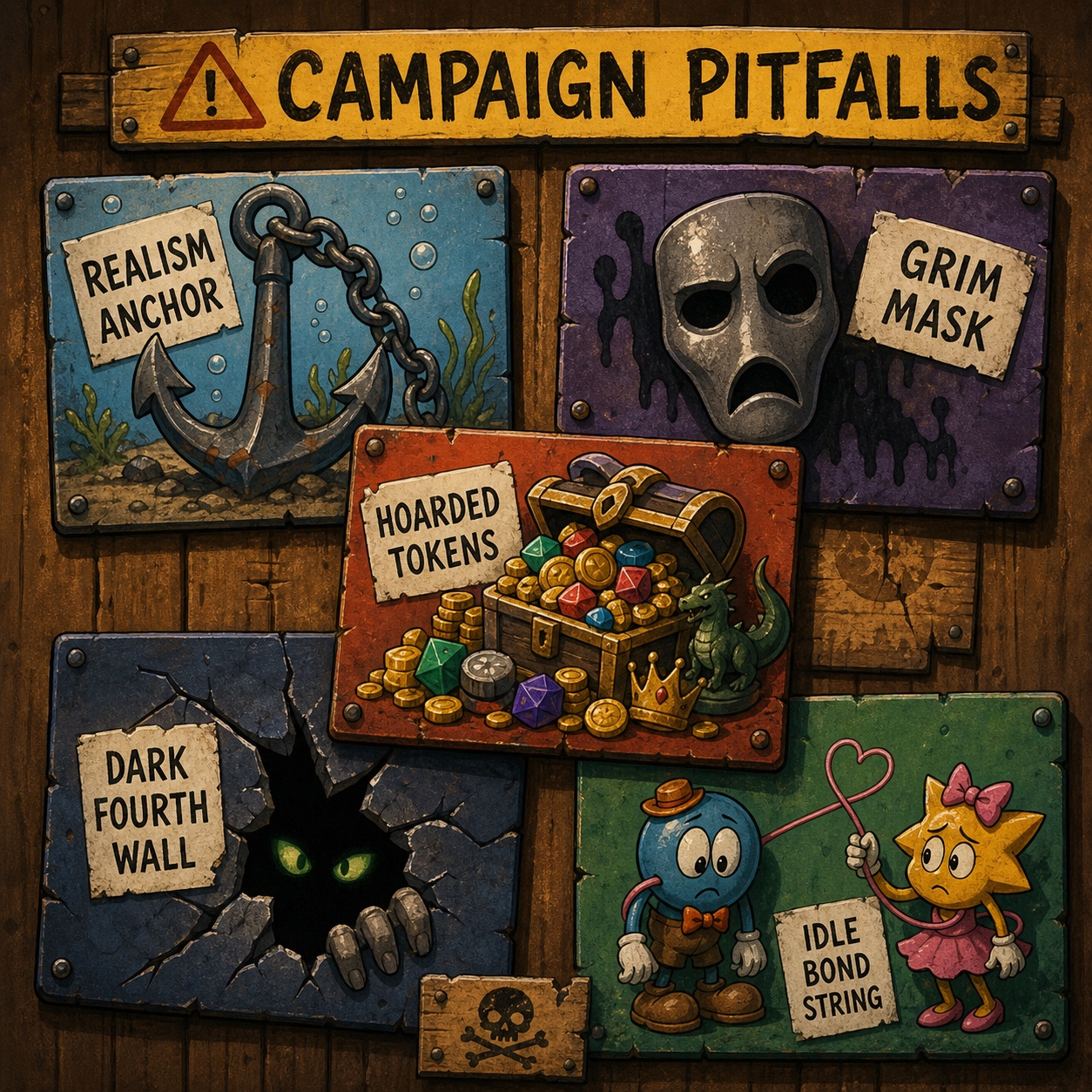
Six failure modes that show up across playtest groups. Each has a diagnosis and a fix.
The table drifts toward realism
Symptom: PCs start refusing to try physics-breaking gags. They roll for everything. They ask is this realistic? The cartoon logic dies.
Fix: Reward the next physics break loudly: award Audience Favor on the spot and describe the gag in cartoon terms (the anvil has a face; it’s smiling as it falls). Tone is contagious, the GM’s first vivid cartoon description usually pulls the table back.
PCs optimize numerically instead of committing to Shtick
Symptom: A player keeps rolling checks that have nothing to do with their Shtick. The Shtick is on the sheet but not in the scene.
Fix: Between sessions, ask the player the one sentence of their Shtick, and ask them which scene this Season made their Shtick most interesting. If they cannot name one, the PC has drifted off the page. Workshop a scene for next episode where the Shtick is unavoidable, a setup only that PC can land.
Villains become serious antagonists
Symptom: The Nemeses (Chapter Nine) stop feeling like colleagues and start feeling like a grimdark threat the players must destroy. The tone shifts.
Fix: Stage a between-scenes moment with a Nemesis: a commissary scene, a backstage scene, a cigarette behind the soundstage. Let the Nemesis be a person. Let the PCs watch the Nemesis lend a stagehand a lighter, or lose an argument about parking. Restore the premise that every adversary is a colleague first.
Elasticity gets treated as Wounds
Symptom: PCs start guarding their Elasticity like hit points. They refuse to take the anvil. They play defensively.
Fix: Reward taking the anvil. Offer a Gag Token at the moment of impact for a particularly spectacular flattening, and narrate the recovery in the cartoon register from Holding the Tone. Elasticity is narrative; if it feels mechanical, describe it until it feels cartoon again.
The Fourth Wall goes dark
Symptom: Three sessions in and nobody has addressed the audience. The Wall is on the sheet but has never come up.
Fix: Have an NPC do it first. A one-off stagehand turns to camera and says something about the scene. The PCs will follow once permission has been visibly granted. If that does not work, build an episode around the Wall, a haunted studio, an audience that has stopped laughing, a visible breakdown in the production.
Bonds sit idle
Symptom: The Bond tracker on two PCs has not moved in three sessions. The relationship is not evolving.
Fix: Write a scene that forces one character to choose between their Bond and their Want. That is the shape of the scene that moves a Bond. It can resolve in either direction, the Bond gets deeper because they chose it, or it gets strained because they chose the Want, but either way the tracker moves, and the table learns that Bonds are meant to be played with.
Pacing
An Ink & Mayhem session should feel like an episode of television. That imposes specific pacing demands that differ from a standard TTRPG session:
- Cold opens should be under 15 minutes of real time. If you are still setting up fifteen minutes in, you have skipped the cold open and started the first act. Cut the cold open shorter; the setup is almost never more interesting than the gag.
- Scenes end on a button. End every scene on a specific image, line, or gag, and narrate that ending frame explicitly.
- Pie fights are short. A full pie fight should resolve in 10–15 minutes of table time. If it is still going at 30 minutes, it has turned into a combat. Cut.
- The second act is where time disappears. Most pacing problems in Ink & Mayhem live in Act Two. Set a rough clock-time goal for Act Three and hold yourself to it; if it is getting late, escalate into the climax even if Act Two is not fully resolved.
- The sting is non-negotiable. End every session with a sting, even if it is unearned: five seconds of a final image.
Edge Cases
Rulings you will need. Each has a default answer; adapt as your table requires.
Can a PC actually die?
Default: No. Permanent retirement of a PC is a Season-level commitment (see Saying Yes), and the player always has final say over it.
What if two PCs have conflicting Shticks in a scene?
Default: Both play In-Shtick. They both get the +1 Boon. The conflict is the scene; let the gag write itself.
What if a player refuses to commit to their Shtick?
Default: coach, do not punish. Take it to a between-session conversation and use the workshop fix from the optimization pitfall above; mechanical penalties for failing to perform turn the game adversarial.
What if the Audience Boos?
Default: the gag is dead for the Season. Name it at the table. The specific bit, character beat, or setup that bombed cannot be reused this Season, it has to evolve. This is rare; reserve it for genuinely misfired moments, not routine bad rolls.
Can Gag Tokens be saved indefinitely?
Default: no. Gag Tokens reset at the start of each session per Chapter Eight. Unspent Tokens do not carry into the next session or past Hiatus.
What happens if the PCs deliberately try to lose the short?
Default: reward the brave choice with Audience Favor. Losing is a valid gag shape. Never punish a deliberate bomb that commits to tone.
Can a PC change Shtick mid-Season?
Default: no. Changes wait for Hiatus (see The Shtick Paradox, above); a mid-Season swap destabilizes the ensemble.
What if a Bond hits −3 (Archenemy)?
Default: play it. A −3 Bond is a dramatic engine. The two PCs are at professional war. They still work together (they are on the same show), but every scene between them carries charge. Bonds at −3 can recover, a single moment of shared peril can move the needle.
What if an NPC gets Wiped Out with no Gag Token to return them?
Default: they return next scene anyway. Adversaries, by setting premise, do not permanently exit. The Tab (for props) or a gentle narrative beat (for named antagonists) handles the rest.
Can a PC be in two places at once?
Default: for one gag, yes. Between scenes, no. The split-screen bit is fine as a gag; the character is in one place at the start of the next scene. If the player wants sustained duplication, that is a Bit (write one).
In This Chapter
- Running Ink & Mayhem: the director stance
- Holding the Tone: golden-age register at the table
- Saying Yes (and When to Say No)
- Difficulty in a Cartoon Universe
- The Shtick Paradox from the GM Chair
- Handling the Fourth Wall
- Audience Favor & Billing: light Season-scale tracking
- Common Pitfalls: six failure modes and fixes
- Pacing
- Edge Cases: ten default rulings
- Safety at the Table
Safety at the Table
Make sure you’re at the right table
Set what you want in the game, get what others want in the game, and follow that. Play the game.
If the table plays in a way that you didn’t agree to, find the table that will. No gaming is better than bad gaming.