PDF Download the Ink & Mayhem Universe Guide 24.0 MB
Character sheet Toon Contract
You are not creating a person. You are casting a role. The toon you build today will be the toon you play through the Season, the same fur, the same voice, the same catchphrase when things go wrong. Nothing about the core of this character changes during active play; that permanence is the appeal. Pick a role you want to wear for a hundred shorts, and the rest will take care of itself.
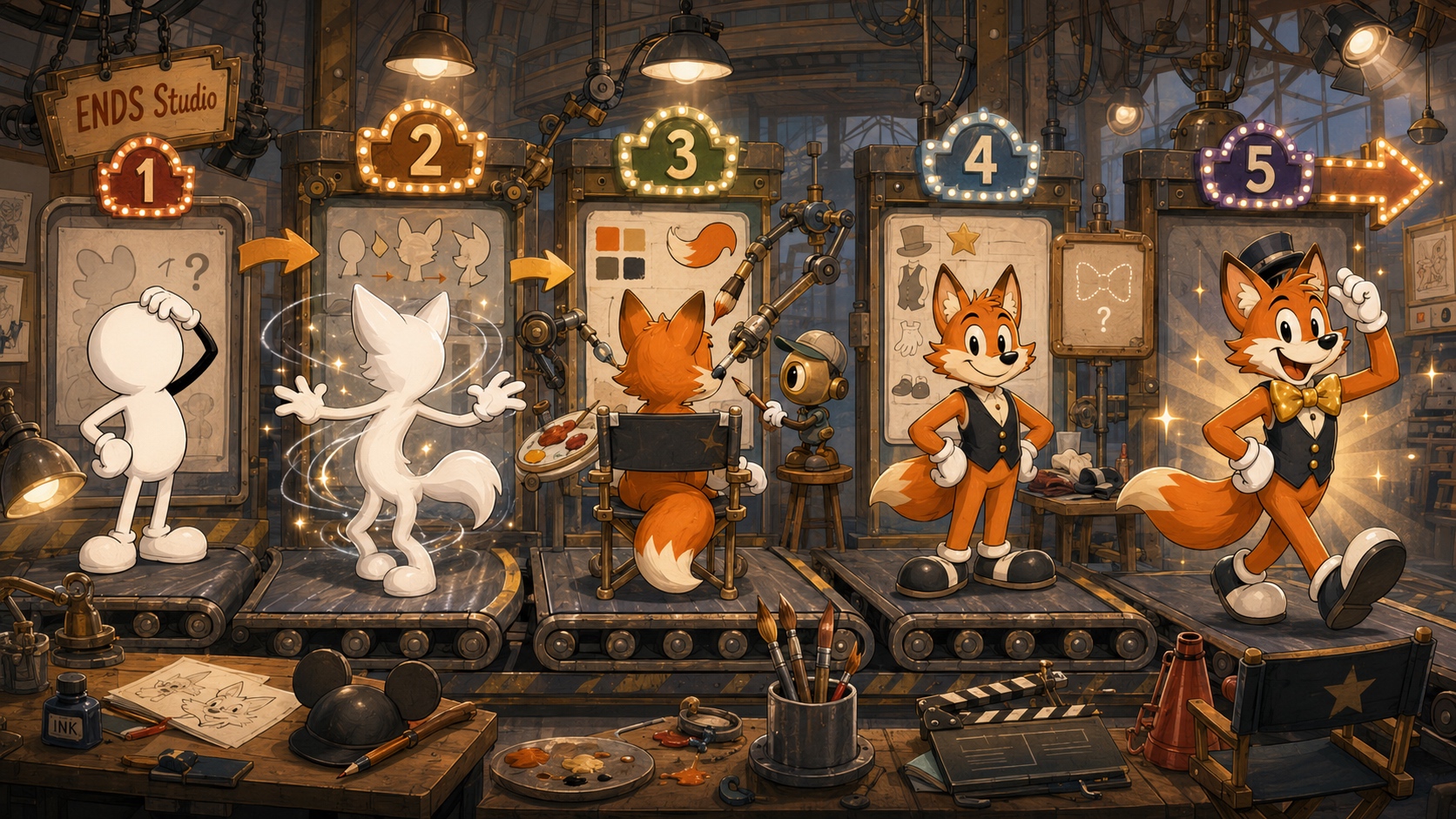
The Character Creation Flow
Character creation in Ink & Mayhem uses the Exodus NDS Core Rules for skills, talents, derived attributes, XP spending, and bookkeeping, with two setting replacements. Type replaces the Core Background-style starting identity for characteristic setup, and Shtick replaces the Core Career-style identity that tells the table what your character does on screen. Characteristics may still be raised during creation by spending starting XP, following the Core Rules and the limits in Chapter Eight.
The full flow is ten steps. Work through them in order.
- Pick your Look (the animal, object, person, or concept your toon resembles).
- Pick your Type (mechanical: the stat block, chosen from six archetypes).
- Pick your Shtick (the locked, one-sentence identity that drives your play).
- Build your starting Bit Repertoire (Bits from Chapter Five, picked to fit your Shtick).
- Choose your Want (your character's long-term goal).
- Form opening Bonds with the other player characters.
- Pick Skills per the Core Rules, drawing from the Chapter Four skill list.
- Pick Talents per the Core Rules, with this book’s additions in Chapter Five.
- Requisition starting Equipment from the ENDS Prop Department (Chapter Six).
- Add finishing touches: name, voice, signature color, catchphrase, and one secret.
Steps 1 through 6 are where Ink & Mayhem diverges from other Exodus NDS settings. The rest is standard character work, filtered through the setting’s menu.
Step 1, Pick Your Look
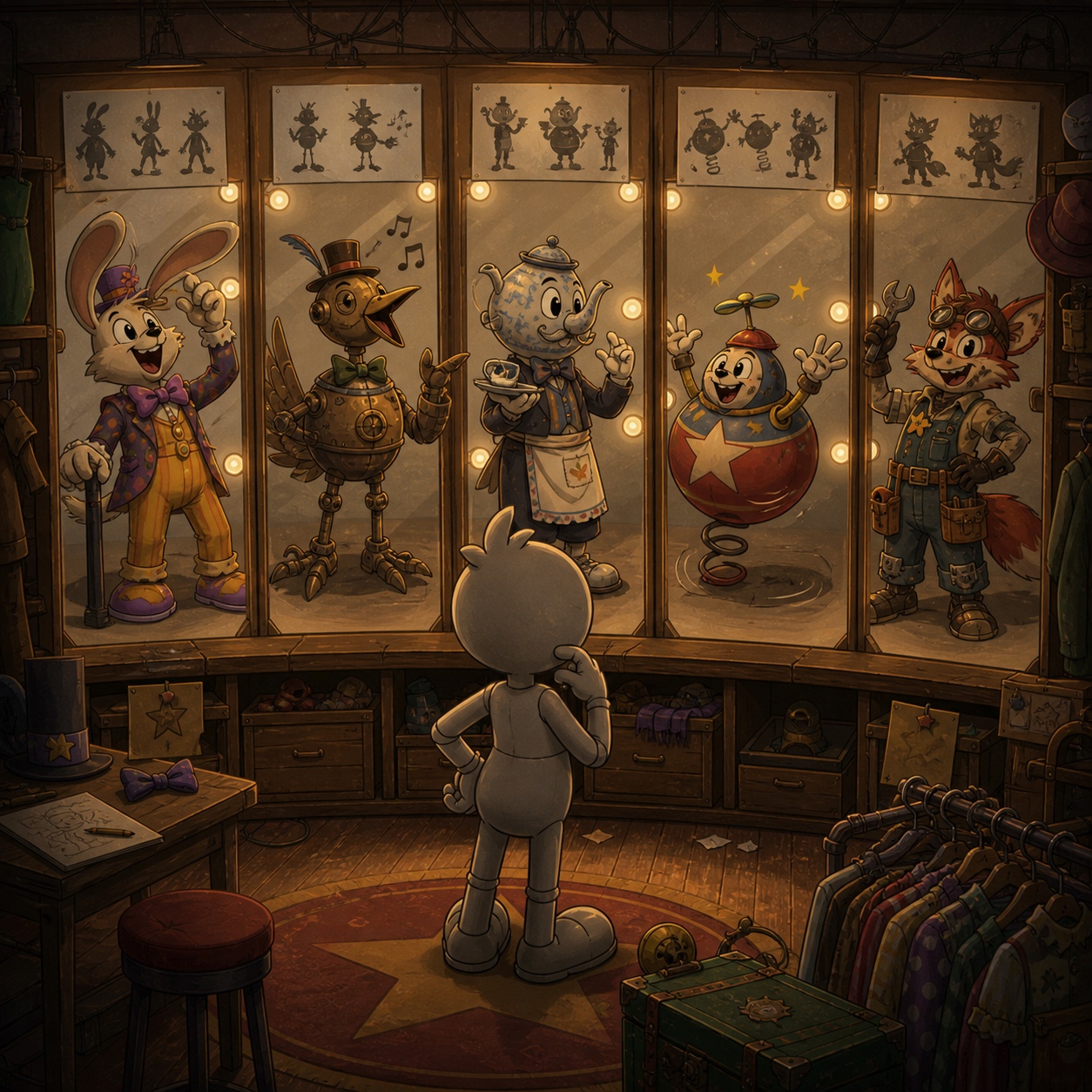
Your Look is what your character is a cartoon of. Rabbit, duck, coyote, cat, mouse, bear, hippo, robot, sentient anvil, anthropomorphized piece of toast: the choice is yours, and it has no mechanical effect whatsoever. The cat and the rabbit sitting across from each other at the table can be mechanically identical and still read as completely different characters in play. Look is the silhouette the animator would draw.
Player toons are Scale 1 by default regardless of Look, unless a specific rule, vehicle, oversized prop, or GM-created adversary assigns a different Scale.
Some guidance:
- Your Look suggests but does not dictate your Shtick or your Type. Any Look can pair with any of them; the tradition supports every combination.
- Duplicate Looks at the table are fine. Two rabbits, two coyotes, two ducks; the ensemble shows of cartoon history were built on this.
- The weirder, the better. A toon whose Look is “a sentient bowling ball with expressive eyebrows” is a valid cartoon character.
Write down what your toon looks like in a single sentence. That sentence is your Look.
Look-Implied Physics Are Narrative Only
Unlike some Exodus NDS settings, Ink & Mayhem attaches no ancestry-like mechanics to a character’s origin. A duck Look does not grant flight, a mouse Look does not grant the ability to fit through gaps, a robot Look does not confer immunity to water, and a sentient-anvil Look does not turn the toon into a weapon. These are flavor permissions. The GM is encouraged to honor them at the narration level (a duck-Look toon may describe a fall as a clumsy glide; a mouse-Look toon may describe squeezing through a vent), but no Look adds dice, removes dice, raises a defense, lowers a difficulty, changes a roll, or grants an automatic Success.
Mechanical advantages from your concept come from Type, Shtick, Bits, talents, equipment, and the Cartoon Physics rules in Chapter Eight. If your toon should mechanically benefit from being small, fast, durable, or weird, that benefit must come from one of those sources.
Step 2, Pick Your Type
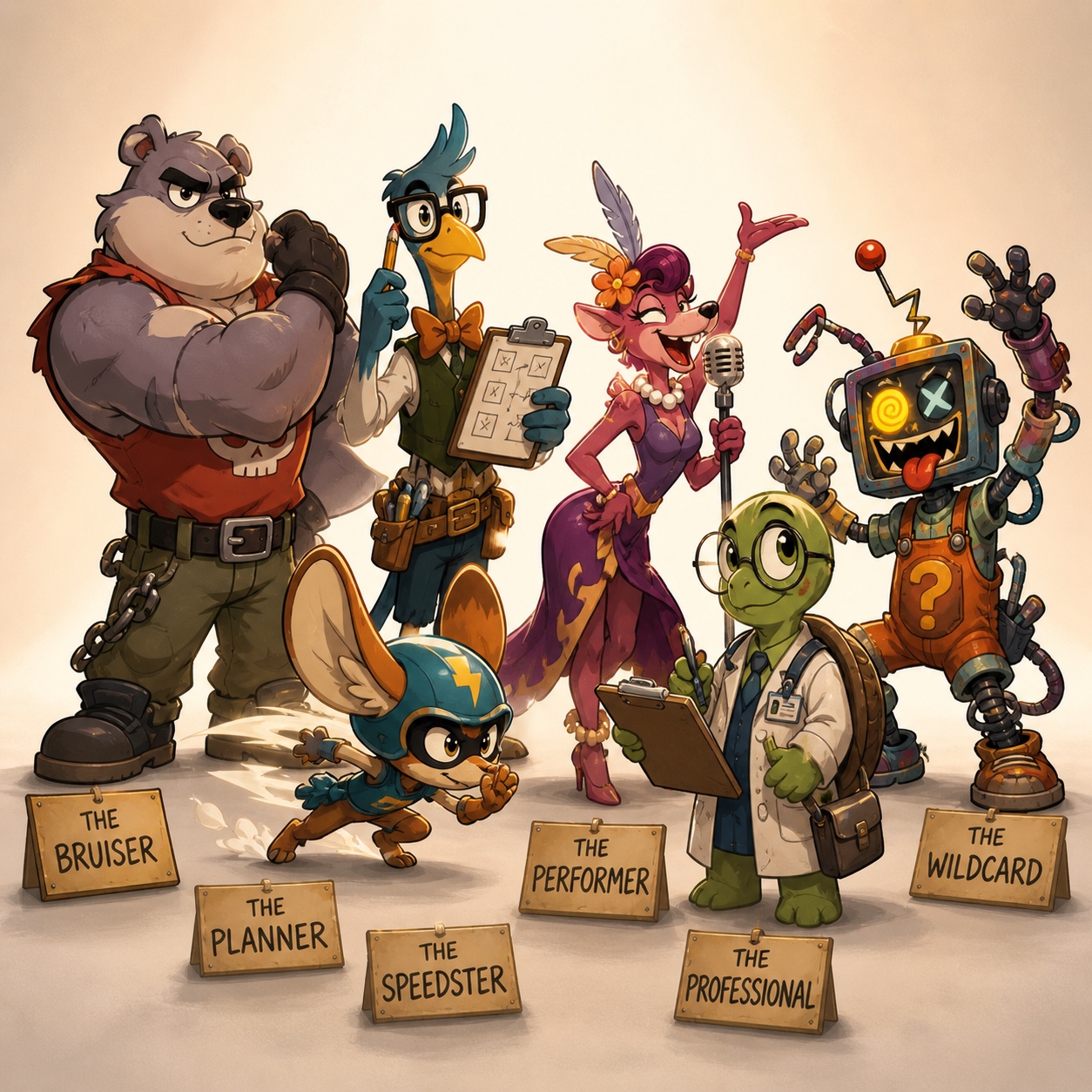
Your Type is your mechanical archetype. There are six. Each is a fixed starting array of characteristics plus one signature passive ability. Pick the one that matches the role you want to play at the table, the tough one, the smart one, the fast one, the charming one, the wise one, or the unpredictable one.
After picking, your six characteristics (Might, Agility, Intellect, Savvy, Willpower, Charisma) are set as listed. You may then reassign one point from any characteristic of 2 or higher to any other characteristic, as long as no characteristic ends above 3 or below 1. After that adjustment, you may spend starting XP on characteristic increases per the Core Rules, to the normal character-creation maximum.
Derived attributes (Elasticity, Strain, defenses) are then calculated per the Core Rules and Chapter Eight of this book.
The Bruiser, “The Tough One”
Built for slapstick. Takes the anvil; laughs it off; throws it back. The Bruiser is whoever the ensemble sends into the cannon first. Looks vary wildly, bears, bulls, boxing kangaroos, hippos, big dumb dogs, hulking ducks, the occasional very large mouse with a glass jaw and a heart of gold.
Characteristics
Signature Ability, Built to Bounce. Your starting Elasticity is +2 above what the formula in Chapter Eight produces. When you are Wiped Out and a Gag Token is spent to return you to the scene, you return at half your maximum Elasticity instead of the usual 1.
The Brain, “The Smart One”
The Brain is the ensemble’s schemer: the one who reads the blueprint, quotes the manual, invents the gadget, and builds the trap. The plans do not always work, but they work often enough to matter.
Characteristics
Signature Ability, Overthinker. Once per scene, you may ask the GM one clarifying question about the current scene (“What’s that device for?” “Where’s the trapdoor?” “What’s his real name?”). The GM must answer truthfully, in-character if appropriate. You cannot use this ability to ask about PC secrets.
The Zip, “The Fast One”
A blur. Leaves dust outlines. Beeps and gets out. Zips spend more time out of the frame than in it, and when they are in it they are usually already halfway through it. The Zip is the engine of the chase.
Characteristics
Signature Ability, Zoom. Once per round, as a Quick Action, you may move to any location you can see within line of sight, ignoring terrain, distance, and intervening obstacles that could plausibly be run around. You cannot carry another character while using this ability, and the GM may require a check for extreme uses (crossing a canyon, moving through a sealed vault).
The Charmer, “The Charming One”
The Charmer is the star, the one the audience already likes. Charmers win fights by not fighting them, get into places by being let in, and walk out of disasters wearing the security guard’s hat. Their Shtick often involves performance; they work a crowd the way a Bruiser works an anvil.
Characteristics
Signature Ability, Audience Favorite. You begin every session with one extra Gag Token above the standard starting count. In addition, whenever you make a social check against a crowd of three or more, you gain 1 automatic Success on the check (added after the roll).
The Pro, “The Wise One”
The Pro is a veteran who has seen every bit, built every trap, and outlived every rival. Working since the Golden Age, the Pro brings that hard-won experience to every short.
Characteristics
Signature Ability, Been Here Before. Once per scene, after rolling a check, you may declare that you have seen this situation before. Re-roll the entire pool (positive and negative dice both). You must take the second result. This ability may not be used on the same check twice.
The Wildcard, “The Unpredictable One”
The Wildcard runs on mood rather than a fixed role. A Wildcard in one scene is fast and charming; in the next, patient and cruel; in the next, the smartest toon in the room. The ensemble never knows which Wildcard will show up tonight.
Characteristics
Characteristics: assign +1 to any one characteristic of your choice, to a maximum of 3
Signature Ability, Rolling with It. When you make a check, you may declare you are using a different characteristic than the one normally associated with the skill. The GM may permit this without a fuss (the default response is yes) or may require brief fictional justification. When permitted, you gain +1 Boon die on the check. This ability may be used once per scene.
Step 3, Pick Your Shtick
Your Shtick is the thing you are in the short. It is a one-sentence, locked-in identity that will not change during a Season. It is the answer the audience has when asked who is this character? before they have seen a single scene.
Every Shtick below is a starting template. The one-sentence identity is the mechanical lock, that sentence is what the table references when ruling on In-Shtick play (+1 Boon die ) and Against-Shtick play (Trial upgraded to Crisis ; see Chapter Eight).
Pick one. Then rewrite the one-sentence identity in your own words if you want, provided the GM agrees it still matches the template. The Starting Bits and Signature Wants listed under each Shtick feed Steps 4 and 5.
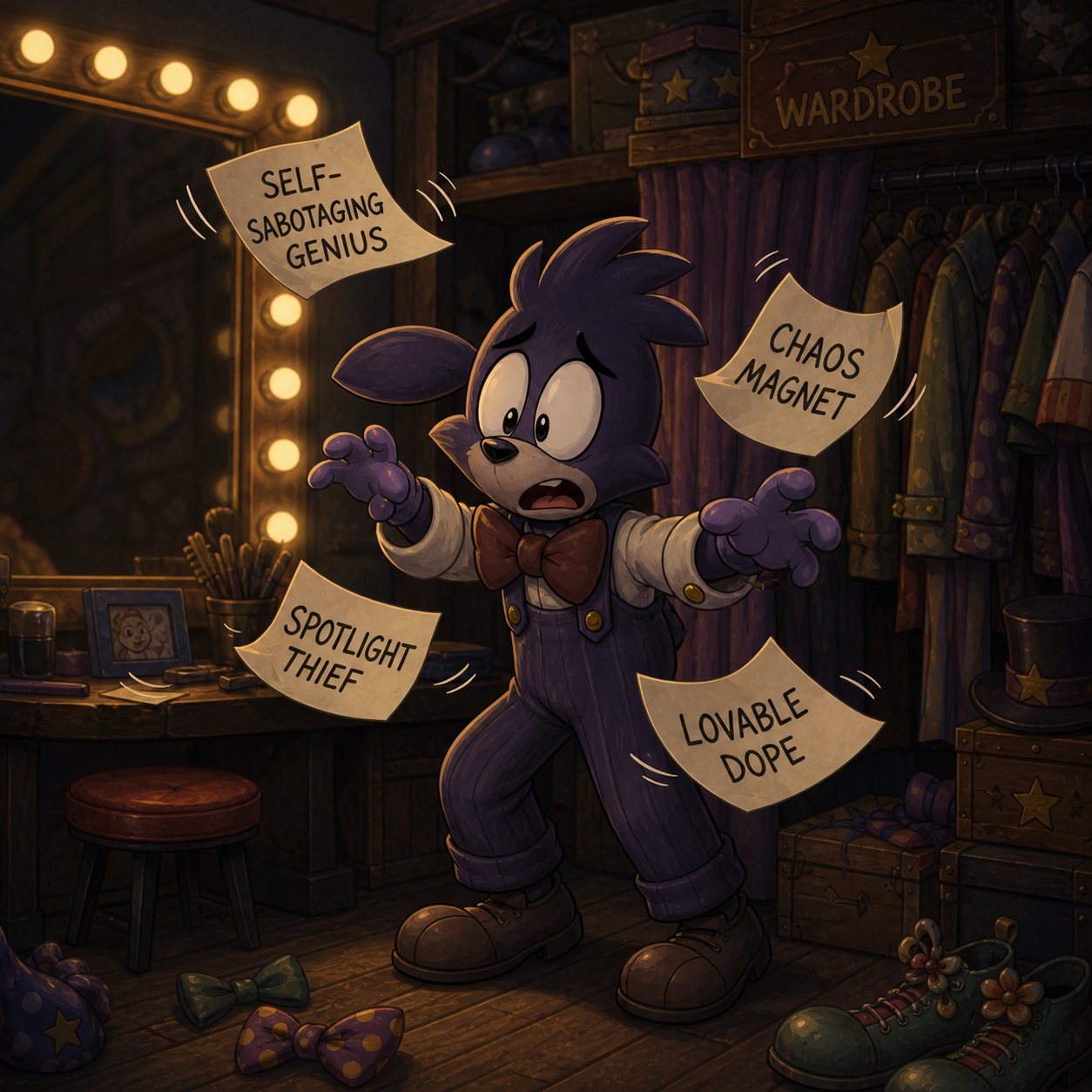
The Self-Sabotaging Genius
One-Sentence Identity: “I have a brilliant plan, and I will ruin it myself.”
You build the better mousetrap. You also build the better mousetrap around yourself. Your genius is genuine, your schemes are ingenious, but your ego, your haste, your refusal to double-check, or your inability to resist one final monologue ensures the plan collapses on you personally. The rival gets away. The audience cheers. You vow this time will be different.
In-Shtick play: conceiving elaborate schemes; monologuing at length; overlooking an obvious flaw; getting caught in your own trap. Against-Shtick play: admitting defeat early; simplifying the plan; letting someone else have the win. Ruling examples: Building a ridiculous birdseed-powered snare while explaining every component is In-Shtick, even if the plan is bad. Quietly walking away because the trap has a flaw is Against-Shtick, because the genius is choosing humility over spectacle.
Starting Bits: Elaborate Trap, Last-Second Monologue, Gadget That Only Works Once, Hindsight Tantrum. Signature Wants: catch the rival once and for all; be recognized as a genius by someone who matters; prove the last scheme would have worked. Touchstones: Wile E. Coyote, Dr. Doofenshmirtz, Dick Dastardly.
The Unflappable Straight Man
One-Sentence Identity: “I am the only reasonable toon in this studio and it is killing me.”
Chaos happens at you. You respond with a sigh, a slow blink to the camera, and a reasonable next sentence. You are the straight man, the anchor the audience grips while everyone else spins.
In-Shtick play: calm responses to outrage; slow takes; quiet exasperation; being the only one left holding the plan when it falls apart. Against-Shtick play: losing your temper; panicking; joining the chaos. Ruling examples: Staring into camera while the cannon smokes beside you is In-Shtick. Grabbing the cannon and firing it wildly because everyone else is doing it is Against-Shtick.
Starting Bits: Deadpan Reaction, The Explanation, Quiet Disapproval, Unbreakable Composure. Signature Wants: a single normal day; a coworker who understands; to finish one conversation without interruption. Touchstones: Bugs Bunny (in straight-man mode), Squidward, Rocko.
The Chaos Magnet
One-Sentence Identity: “Disasters find me. I survive them. I do not learn.”
Where you go, calamity goes. Anvils aim for you. Stage flats fall on you. Costars trip you. You have been flattened so many times the Prop Department knows your outline. You are indestructible in the cartoon sense, the next scene always finds you whole, but you are never the one driving the disaster. You are the disaster’s favorite subject.
In-Shtick play: walking into traps; being at the wrong place; absorbing the hit meant for someone else; emerging bewildered but unbroken. Against-Shtick play: anticipating danger; successfully dodging; avoiding the trap entirely. Ruling examples: Opening the door marked DO NOT OPEN and being swept away by paint is In-Shtick. Studying the hinges, spotting the bucket, and neatly stepping around the trap is Against-Shtick.
Starting Bits: Anvil Magnet, Disaster Survival, Wait What Just Happened, The Unfortunate Nap. Signature Wants: one peaceful afternoon; to understand what keeps happening; to find out who keeps dropping things on you. Touchstones: Donald Duck, Daffy Duck (flustered mode), Charlie Brown.
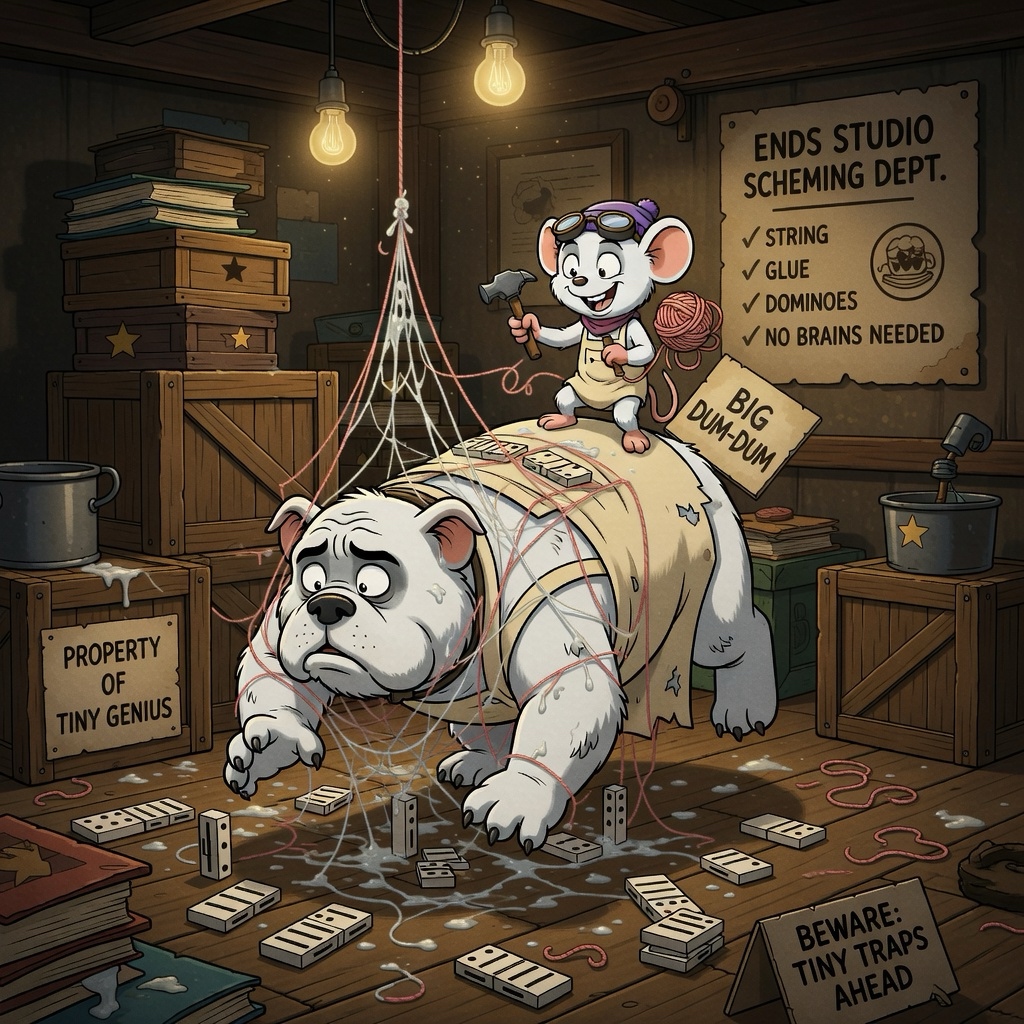
The Scheming Little One
One-Sentence Identity: “I am small, I am clever, and I will win because you underestimated me.”
You are tiny. Your enemies are not. This is their mistake. You scheme, you plot, you plant string, you set up dominoes, and when the Bruiser across the street lifts the net, you are already gone and they are already upside down. Your power is leverage, and your leverage is that nobody takes you seriously.
In-Shtick play: setting up elaborate setups with cheap materials; taunting from a height; talking rings around larger opponents; escaping through holes they cannot fit through. Against-Shtick play: fighting openly; being earnest with an enemy; being caught napping. Ruling examples: Rigging a hallway with string, glue, and a rude sign is In-Shtick. Challenging the Bruiser to a fair boxing match in an open ring is Against-Shtick.
Starting Bits: The Dawdle, Fast Talk, Improvised Booby Trap, Size Does Not Matter. Signature Wants: outsmart the Bruiser on every block; be acknowledged as the biggest fish in the pond; inherit the studio. Touchstones: Jerry Mouse, Speedy Gonzales, Stewie Griffin, Yakko.
The Imperturbable Professional
One-Sentence Identity: “I am a master of an absurd craft and I take it completely seriously.”
You are a detective. Or a samurai. Or a lawyer, or a doctor, or an opera singer, or the world’s foremost authority on cheese. Whatever your craft is, you pursue it with the full weight of your dignity. The fact that the world around you is a cartoon does not change how you operate. You deliver your monologues in full. You wear the full regalia. You are, above all, a professional.
In-Shtick play: formal speech; taking the ridiculous seriously; extensive jargon; refusing to break character under pressure. Against-Shtick play: acknowledging the absurdity; cracking a joke at your own expense; showing up informal. Ruling examples: Cross-examining a banana peel as if it were a hostile witness is In-Shtick. Saying “this is dumb” and dropping the case to go get lunch is Against-Shtick.
Starting Bits: Expert Testimony, Full Regalia, Professional Courtesy, The Monologue Is the Point. Signature Wants: solve the case of a lifetime; be acknowledged by peers who do not exist; perfect the craft. Touchstones: Inspector Clouseau, Foghorn Leghorn (in senatorial mode), The Brain.
The Spotlight Thief
One-Sentence Identity: “If a camera is on, I am in front of it.”
You exist to be seen. The audience is a drug and you are not going to apologize for it. You upstage. You improvise. You burst into song if the short allows and sometimes if it does not. The short is about you by the end, regardless of what was scripted.
In-Shtick play: upstaging others; taking credit; breaking into unscripted song or dance; addressing the audience; performing. Against-Shtick play: letting someone else shine; quiet humility; refusing applause. Ruling examples: Turning someone else’s chase into your tap number is In-Shtick. Holding the spotlight steady so another PC can finish their emotional speech is Against-Shtick.
Starting Bits: Sudden Musical Number, Steal the Scene, Ham It Up, To the Camera. Signature Wants: top billing; an award no rival has; one scene of undivided attention. Touchstones: Daffy Duck (showman mode), Bugs Bunny (performer mode), Miss Piggy, Dot Warner.
The Loose Cannon
One-Sentence Identity: “I am explosive, I am beloved, and you are next.”
You arrive in a cloud of debris. You leave in one. Things break around you by default. Authority is a suggestion you choose to ignore. Other toons adore you and fear you in equal measure, and the studio keeps renewing your contract because the audience cannot get enough of you, even though, on paper, you are a complete liability.
In-Shtick play: property destruction; reckless decisions that pay off; cheerful ignorance of consequences; solving problems with dynamite. Against-Shtick play: careful planning; preserving property; showing restraint. Ruling examples: Lighting the fuse because “doors are suggestions” is In-Shtick. Reading the evacuation diagram, filing the permit, and choosing the quiet hallway is Against-Shtick.
Starting Bits: Pocket Dynamite, Crash the Scene, No Brakes, Collateral Damage. Signature Wants: be beloved by the audience forever; outlive every rival; never, ever be calmed down. Touchstones: Taz, Yosemite Sam, Woody Woodpecker, Daffy Duck (at his most unhinged).
The Lovable Dope
One-Sentence Identity: “I am happy, I am wrong about most things, and I love you.”
You are simple rather than stupid. The world makes sense to you in a way it does not make sense to the clever toons, and that sense is almost always off by about fifteen degrees, but it is sincere, and it is warm, and nobody in the ensemble can bring themselves to correct you for long. You are the heart of the group. You are also the reason the plan keeps failing.
In-Shtick play: misunderstanding the plan; asking the sincere question; radiating warmth; making a mistake that turns out to work; loving everyone on-set. Against-Shtick play: grasping the plan correctly; cynicism; withdrawing affection. Ruling examples: Handing the villain the “secret” map because they asked nicely is In-Shtick. Coldly spotting the double-cross and refusing to help because friendship is inefficient is Against-Shtick.
Starting Bits: Sincere Question, Accidental Genius, Big Hug, The Wrong Thing That Works. Signature Wants: everyone on the lot to be friends; one more snack; to understand what just happened. Touchstones: Patrick Star, Homer Simpson (at his warmest), Winnie the Pooh, Ralph Wiggum (at his most lovable), Porky Pig.
Step 4, Build Your Starting Bit Repertoire
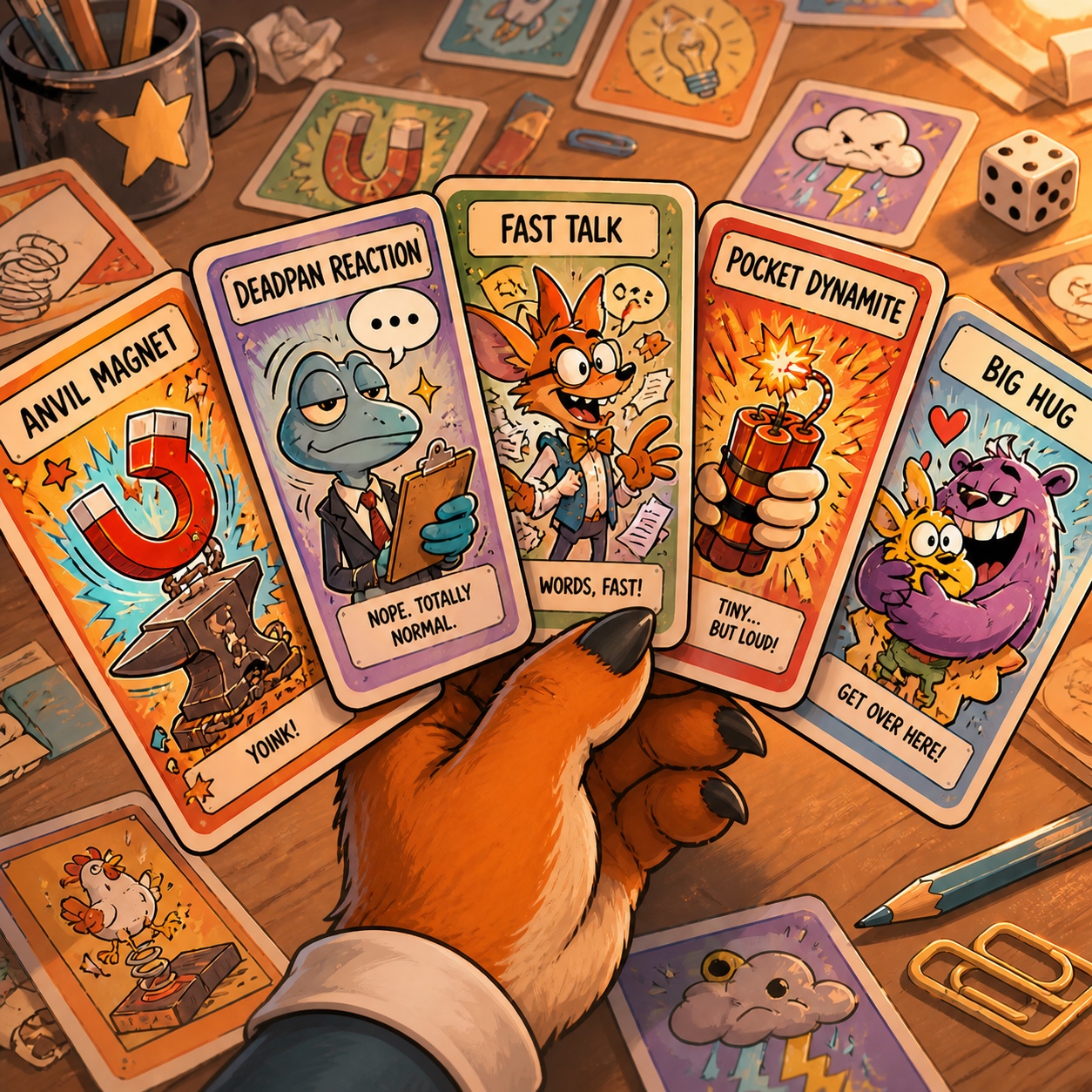
Your Bit Repertoire is your active toolkit, the specific cartoon moves your character can pull from scene to scene. Each Bit is an activated ability, purchased from the menu in Chapter Five. Every character starts with three Bit slots. Two of those slots should be filled by bits suggested under your Shtick above (your Shtick’s starting bits); the third is wide open, pick any bit from Chapter Five that fits your concept, regardless of Shtick.
Your Repertoire grows over play, up to a maximum of six Bit slots (see Chapter Eight, The Shtick System). XP spent on new bits is one of the primary progression pathways in this book.
Step 5, Choose Your Want
Your Want is the long arc of your character. It is the thing you are chasing, and the game promises you will not catch it quickly or cheaply. This is a feature, the Want is what keeps the campaign running for seasons at a time.
A good Want is:
- Phrased as a hard-to-complete goal. “Catch the rival for good.” “Win Best Picture.” “Be the one the audience remembers.” “Finally settle down with the one.”
- Visible on-screen frequently. Your Want should be the thing the GM can use to frame a short. “I want to catch the rival” is better than “I want inner peace,” because the rival can appear in the next scene and inner peace cannot.
- In tension with another PC’s Want or Shtick. The group’s dynamic comes from Wants that pull against each other. If the Spotlight Thief wants top billing and the Pro wants to retire quietly, the GM has ready-made conflict for every short.
Your Shtick’s Signature Wants (listed above) are a suggested menu. You may pick one verbatim, modify one, or write an original, the GM is the final arbiter.
Step 6, Form Opening Bonds
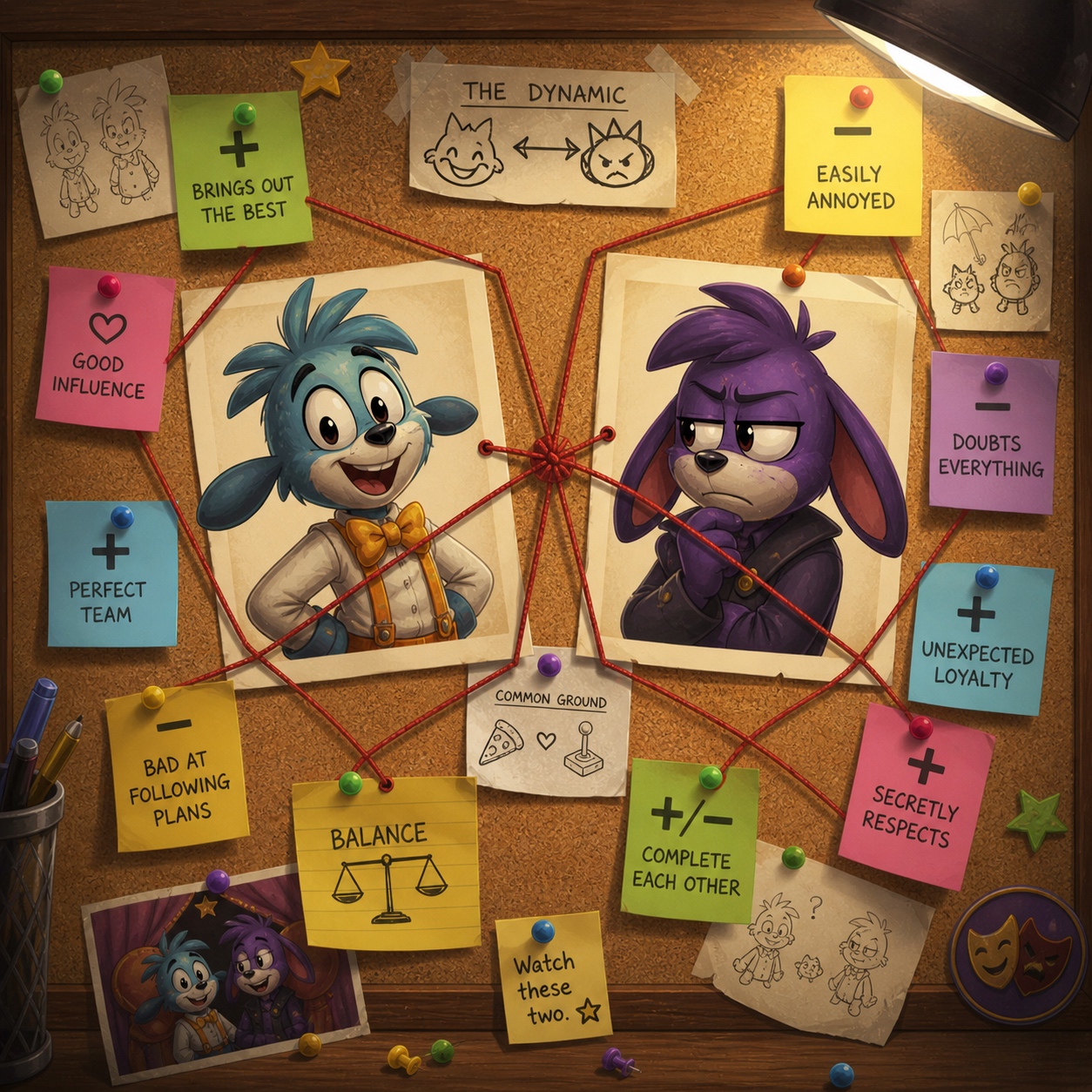
Your Bonds are your starting relationships with the other player characters. At the table, each player states one Bond with each other PC at creation, ranging from −1 (minor friction) to +1 (mild warmth). You cannot start with a Bond above +1 or below −1; deeper connections and grudges are earned in play.
Mechanical rules for Bonds are in Chapter Eight. At creation, write them down on the character sheet and say the sentence out loud: “I have a +1 Bond with [name] because we used to voice the same character until she took over.” That sentence becomes table-shared canon.
Bonds with NPCs are not created here; they will emerge in play as the GM introduces the ensemble.
Step 7, Skills
Select skills per the Core Rules, drawing from the modified skill list in Chapter Four, which renames a few Core skills and adds cartoon-specific skills such as Gag-Craft and Fourth-Wall.
Your profession skills come from three sources:
- Your Type grants four profession skills (the Wildcard grants three; see the table).
- Your Shtick grants four profession skills.
- The four Cartoon Skills, Gag-Craft, Pratfall, Fourth-Wall, and Performance, are profession skills for every Ink & Mayhem toon.
Duplicate skills do not grant extra discounts or free ranks. Profession skills are simply the skills you buy at the cheaper Core Rules cost.
| Type | Profession Skills |
|---|---|
| Bruiser | Brawl, Melee, Athletics, Resilience |
| Brain | Craft, Lore, Science, Perception |
| Zip | Athletics, Coordination, Drive, Stealth |
| Charmer | Charm, Deception, Negotiation, Performance |
| Pro | Readiness, Leadership, Lore, Perception |
| Wildcard | Choose any three non-Cartoon Skills that fit the toon |
| Shtick | Profession Skills |
|---|---|
| Self-Sabotaging Genius | Gag-Craft, Craft, Science, Deception |
| Unflappable Straight Man | Readiness, Perception, Resilience, Leadership |
| Chaos Magnet | Pratfall, Resilience, Perception, Survival |
| Scheming Little One | Subterfuge, Stealth, Deception, Gag-Craft |
| Imperturbable Professional | Choose any four skills tied to the declared profession |
| Spotlight Thief | Performance, Charm, Fourth-Wall, Deception |
| Loose Cannon | Brawl, Ranged, Athletics, Intimidation |
| Lovable Dope | Charm, Pratfall, Resilience, Perception |
Step 8, Talents
Select talents per the Core Rules, including the free Tier 1 universal talent granted at character creation. Your Type’s Signature Ability is also free and does not count against your talent budget. Bits in your Repertoire (Step 4) are not talents and do not count either; they are a parallel subsystem. All remaining talents come from the list in Chapter Five.
Step 9, Equipment
New characters are ENDS Studio talent. You begin with a contracted line of credit at the ENDS Prop Department, detailed in Chapter Six. Requisition your starting gear from that catalog, subject to your starting-equipment allowance (see the opening of Chapter Six for the specific budget). You may buy individual items or choose one of the starting gear packages in Chapter Six. Anything in the catalog is available; if you want something not in the catalog, ask the GM.
Step 10, Finishing Touches
The final pass brings the character to life on the page. Fill in:
- Name. The thing the audience will say. One name or two. Punchy helps. A pun is acceptable.
- Voice. Write down how your toon sounds in one phrase. (“Slow drawl,” “screechy and fast,” “mumbles constantly,” “formal with a slight lisp.”) The player will be doing this voice, so keep it sustainable.
- Signature Color. One color on the character sheet that the animator would put on this toon above all others. Useful for the GM’s table notes.
- Catchphrase. One or two lines your toon repeats. Not required (many classic toons never had one), but most players want it.
- One Secret. A single fact about your toon that no other PC knows at the start. This is the GM’s tool for pulling you into scenes later. Write it down; share it privately with the GM if you want.
Character Creation Example
Pip Sprocket is a mouse inventor, hallway saboteur, and professional bad influence.
Pip’s player starts with the concept: a tiny toon who turns every straight line into a trap. For the Look, “small gray mouse in goggles and a stolen lab coat” is enough.
Pip chooses The Zip, “The Fast One” as Type. The starting characteristics are:
The player then reassigns one point from Charisma to Intellect, because Pip is more technical than lovable. Before XP, Pip’s characteristics are:
Pip chooses The Scheming Little One as Shtick.
One-Sentence Identity: “I am small, overprepared, and already behind you.”
Pip’s profession skills are Athletics, Coordination, Drive, Stealth from Type; Subterfuge, Stealth, Deception, Gag-Craft from Shtick; and the four universal Cartoon Skills: Gag-Craft, Pratfall, Fourth-Wall, Performance. Duplicates do not matter, so Pip’s final profession skill list is Athletics, Coordination, Drive, Stealth, Subterfuge, Deception, Gag-Craft, Pratfall, Fourth-Wall, and Performance.
Pip starts with three filled Bit slots. Two come from the Shtick list, and the third is another fitting catalog Bit:
- The Dawdle
- Improvised Booby Trap
- Fast Talk
Pip’s free Tier 1 universal talent is Specialist: Gag-Craft with cheap trap timing. Once per scene, Pip adds 1 Boon die when making that narrow kind of Gag-Craft check.
Pip has 80 starting XP and spends it as follows:
| Purchase | Cost |
|---|---|
| Raise Savvy to 3 | 30 XP |
| Gag-Craft rank 1 | 5 XP |
| Gag-Craft rank 2 | 10 XP |
| Stealth rank 1 | 5 XP |
| Stealth rank 2 | 10 XP |
| Subterfuge rank 1 | 5 XP |
| Deception rank 1 | 5 XP |
| Pratfall rank 1 | 5 XP |
| Coordination rank 1 | 5 XP |
| Total Spent | 80 XP |
After XP, Pip’s resulting characteristics are:
Pip’s key starting dice pools are:
| Check | Pool |
|---|---|
| Gag-Craft trap setup | Intellect 3 + Gag-Craft 2 |
| Stealth through scenery | Agility 3 + Stealth 2 |
| Coordination stunts | Agility 3 + Coordination 1 |
| Subterfuge locks and sneaking tricks | Agility 3 + Subterfuge 1 |
| Deception excuses | Charisma 2 + Deception 1 |
| Pratfall damage mitigation | Agility 3 + Pratfall 1 |
Pip’s derived values are:
| Derived Value | Calculation | Result |
|---|---|---|
| Resistance | half Might rounded up + armor | 1 + armor |
| Elasticity | 10 + Might | 11 |
| Strain Points | 10 + Willpower | 12 |
| Melee Defense | Starting value | 0 |
| Ranged Defense | Starting value | 0 |
For Step 9, Pip chooses the Backlot Trickster starting gear package from Chapter Six. The package spends the full 500 PC starting line of credit and gives Pip a Trap Kit, Costume Trunk, Pocket Hole, banana peels, sign paint, disguise tools, whoopee cushions, grappling hook, stopwatch, Studio ID, slingshot, smoke bomb, and Hammerspace Reinforcement.
For Step 10, Pip’s player fills in the finishing touches:
- Want: “Prove small plans beat big muscles.”
- Voice: fast, overconfident, always whispering too loudly.
- Signature Color: blueprint blue.
- Catchphrase: “Technically, this already worked.”
- One Secret: Pip used to work in the Prop Department and still has a key to one unlabeled cabinet.
Opening Bonds are table-specific. In a three-PC group, Pip might start with +1 toward the Unflappable Straight Man because they always explain the plan afterward, and −1 toward the Loose Cannon because they keep detonating the plan early.
Signature Characters Are Not Starting PCs
The named characters presented throughout this book are signature NPCs, rivals, allies, and examples from the Ink & Mayhem world. Their suggested skill ratings, signature Bits, and special ability blocks are not character-creation templates and may exceed starting PC limits.
Signature Bits are not catalog Bits. Where a signature character carries a Bit whose name does not appear in the Chapter Five catalog, that Bit is a signature variant unique to that character. Signature variants do not belong to any one Shtick, do not enter the catalog, are not available to PCs through normal advancement, and may resolve differently from any catalog Bit they thematically resemble. When in doubt, the catalog Bit is canonical for PCs; the signature variant is canonical only for the named character it lives on.
In This Chapter
- The ten-step character creation flow
- Look
- Type: the six archetypes
- Shtick: the eight locked identities
- Bit Repertoire
- Want
- Bonds
- Finishing touches
- A complete starting character example